PART 1
CRACK!
The sickening snap of my left forearm breaking in half shattered the solemn commendation hall at Fort Bragg.
One second, the Purple Heart had just been pinned to my chest.
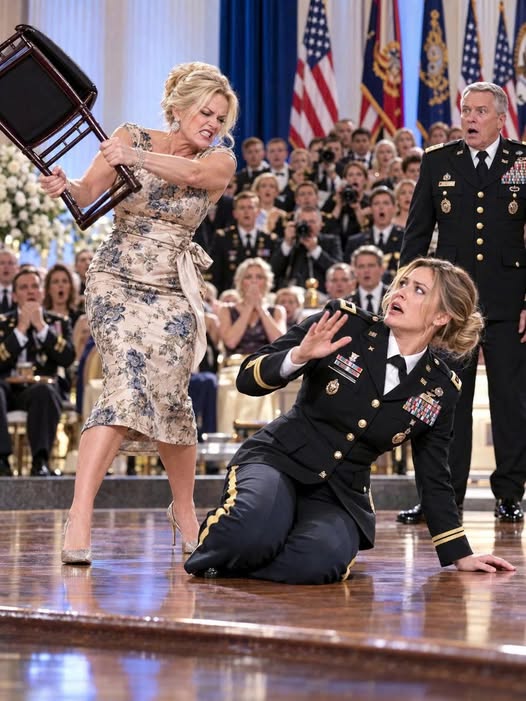
The next, a heavy steel folding chair came crashing across my left arm like an executioner’s blade.
The violent force buckled my knees.
My newly awarded medal tore loose, striking the oak floorboards with a hollow ping as I collapsed in blinding agony.
Looming over me with the bent steel frame was my stepmother, Brenda, her face contorted in pure vitriol: “You’re still nothing but trash in a costume, you whore!”
Three hundred veterans, mayors, and combat soldiers froze in suffocating shock.
In the third row, my cowardly father, Thomas, slumped in his seat, staring at his shoes, while my stepbrother, David, let out an amused snicker.
For twenty years, my father had simply handed her the weapon and looked the other way.
As I cradled my shattered arm, a heavy, unyielding hand clamped onto my shoulder.
Lieutenant General Robert Hayes stepped forward.
Three silver stars gleamed on his lapels, but his face held a terrifying, glacial fury capable of leveling a battlefield.
“She is not trash,” the General’s voice cut through the silence like an artillery shell. “She is Nora—the soldier who carried bleeding Americans out of a burning hellscape under heavy fire. And you… just brutally assaulted her at her own commendation ceremony.”
Two towering Military Police officers marched up the aisle in terrifying synchronization, kicking the bent steel chair out of the way as combat medics sprinted onto the stage.
Yet Brenda’s hysteria refused to die: “You military people just don’t understand her! She plays the innocent victim, but she’s been doing this her entire life!”
General Hayes rose slowly to his full, commanding height: “Doing what, exactly?”
Brenda looked around, realizing that three hundred pairs of eyes were burning into her like daggers.
Any rational person would have stopped. But Brenda’s narcissism had never been rational
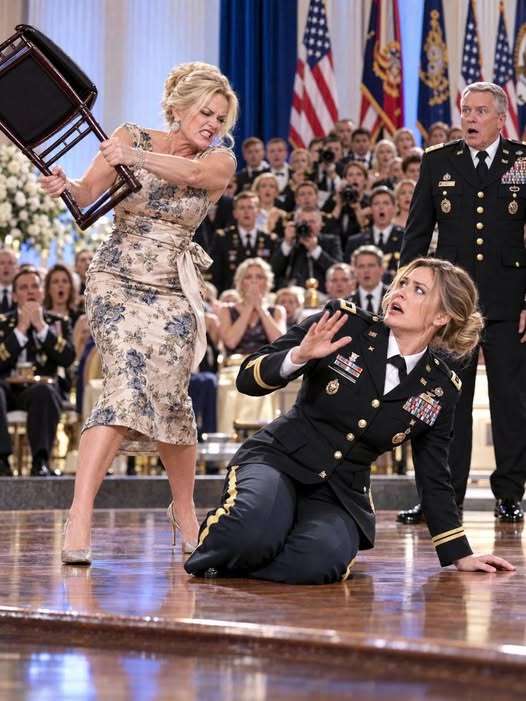
Brenda’s mouth opened, but for the first time since she had stormed onto that stage, no sound came out. Lieutenant General Robert Hayes did not move toward her. He did not need to. Two Military Police officers now stood between us, while three hundred witnesses remained completely silent. Even through the haze of pain, I could see something changing in Brenda’s face. Rage was slowly being replaced by fear.
“She lies,” Brenda finally spat. “That’s what she does. Nora has always lied. She lies about us. She lies about her childhood. She lies about being some kind of hero. She probably lied to all of you too.”
A murmur moved through the auditorium.
General Hayes stared at her.
Then he turned toward the audience.
“Nora,” he said calmly, “has spent most of her military career forbidden from discussing what she actually does.”
Brenda gave a short, ugly laugh.
“Exactly. Convenient.”
Hayes looked back at her.
“No, Mrs. Bennett. Classified.”
That one word changed the entire room.
My father finally lifted his eyes from the floor.
David stopped smiling.
Brenda’s grip loosened on the twisted chair frame before one of the MPs took it away from her.
General Hayes stepped beside me as the medics worked, careful not to obstruct them. Then he looked toward the rows of soldiers, veterans, civic leaders, and officers who had come to watch what my family apparently believed was nothing more than a decorative ceremony.
“The woman you just assaulted is Major Nora Bennett.”
My father’s head snapped upward.
Brenda went completely still.
David whispered, “Major?”
I closed my eyes.
So much for keeping that quiet.
For nearly six years, my family had believed I was an administrative officer working somewhere inside Army logistics. I had allowed them to believe it because the truth had never belonged to them. They mocked my career anyway. Brenda called me a government secretary. David joked that I probably spent my days ordering printer paper. My father never corrected them because he never bothered asking what I really did.
General Hayes continued.
“Major Bennett commanded a joint evacuation element during the attack for which she was wounded. When communications failed and part of the convoy became trapped, she remained behind after being ordered toward extraction.”
The auditorium was silent again.
“She coordinated the evacuation of seventeen wounded personnel and three civilian interpreters while enemy fire continued around their position.”
Brenda shook her head violently.
“No.”
Hayes ignored her.
“She refused evacuation until the final casualty was loaded.”
“No,” Brenda repeated.
“Several people in this room,” Hayes said, “are alive because she did.”
Someone in the audience stood.
I recognized Sergeant First Class Miguel Alvarez.
Then another soldier rose.
Then another.
Within seconds, almost an entire section of the auditorium was standing.
Some had been with me that day.
Some had treated the wounded afterward.
Some simply knew what had happened.
Brenda stared at them.
For the first time in my life, she had no version of reality powerful enough to overpower the room.
One of the medics leaned close to me.
“Major, we need to move you.”
I nodded.
As they prepared to take me from the stage, General Hayes bent slightly so only I could hear him.
“This isn’t over.”
I assumed he meant the assault.
I was wrong.
He looked toward David.
“Not even close.”
David heard him.
The color vanished from my stepbrother’s face.
I was halfway toward the side entrance when Brenda suddenly lunged against the MPs restraining her.
“You think she’s innocent?” she screamed. “Ask her why investigators keep calling our house! Ask her what she did to David’s company!”
That stopped me.
Not because of what Brenda said.
Because of what she had accidentally admitted.
General Hayes’s expression sharpened.
My father stood so quickly that his chair scraped backward.
“Brenda, stop talking.”
She turned toward him.
“What?”
“I said stop.”
It was the first command I had heard my father give her in twenty years.
Brenda stared at him in disbelief.
David did too.
Then General Hayes slowly looked from Thomas to Brenda.
“So you knew about the investigation.”
My father froze.
Nobody moved.
Hayes’s voice became quieter.
“That is extremely useful information.”
My father immediately shook his head.
“I don’t know what you’re talking about.”
But the damage was already done.
A woman in a dark suit rose from the second row.
I recognized her instantly.
Special Agent Marisol Trent.
Army Criminal Investigation Division.
Brenda stared at her.
David whispered something under his breath.
Agent Trent walked toward the stage and removed a credential case from inside her jacket.
“Thomas Bennett?”
My father backed away from his chair.
“This is a family matter.”
Trent’s expression did not change.
“No, sir. It stopped being a family matter months ago.”
I had known Agent Trent for twelve weeks.
My family had never seen her.
That was intentional.
Three months earlier, while recovering from the injuries that had eventually brought me to this ceremony, I had been asked to identify equipment recovered from the convoy attack. Most of it was routine. Damaged communications units. Torn medical packs. Protective equipment. Vehicle components.
Then I saw a manufacturer’s code that made my stomach drop.
Horizon Tactical Solutions.
David’s company.
My stepbrother had started Horizon seven years earlier and spent every family gathering bragging about how successful he had become. He called himself a defense entrepreneur. Brenda called him a genius. My father told anyone who would listen that David had built everything from nothing.
I had never cared enough to investigate what Horizon actually supplied.
Until that afternoon.
One of the equipment specialists showed me a protective component that had failed inspection after the attack.
Then another.
Then six more.
The paperwork attached to them said they had passed every required standard.
The physical evidence suggested something very different.
I remember staring at David’s company logo and feeling something colder than anger.
Recognition.
Because David had once bragged at Thanksgiving that government contracts were “basically free money if you knew the right people.”
At the time, I thought he was being obnoxious.
Now investigators wanted to know whether he had been serious.
I gave them every piece of information I had.
Then they told me something that made the situation far worse.
Horizon Tactical Solutions did not merely have questionable inspection records.
Investigators believed somebody inside the company had been replacing approved materials with cheaper alternatives after inspections were completed.
The paperwork remained legitimate.
The products did not.
Millions of dollars had moved through a chain of subcontractors and shell companies.
And several of those companies traced back to people connected with my family.
I had spent weeks trying to accept what that meant.
The answer was standing inside the auditorium.
My father.
My stepmother.
My stepbrother.
Agent Trent stopped directly in front of Thomas.
“Sir, please remain where you are.”
My father tried to smile.
It was the same smile he had used throughout my childhood whenever teachers questioned bruised feelings, unexplained absences, or why I suddenly stopped speaking whenever Brenda entered a room.
Polite.
Weak.
Calculated.
“You’re making a mistake,” he said.
Agent Trent glanced toward the security cameras mounted above the stage.
“I doubt that.”
My father followed her gaze.
Something inside him changed.
He finally understood.
The entire attack had been recorded.
Not by one camera.
By seven.
The commendation hall had permanent security coverage, military photographers, livestream equipment for families, and dozens of witnesses holding phones.
Whatever plan my family had walked into that building carrying had just collapsed in public.
Brenda apparently realized it too.
She twisted toward David.
“You told me she was trying to destroy us!”
David hissed, “Shut up.”
“I did this because you said—”
“Mom.”
“You said if she looked unstable in front of military officials, they wouldn’t trust her testimony!”
The auditorium seemed to inhale at once.
David’s face went white.
My father closed his eyes.
Agent Trent said nothing.
She did not need to.
Brenda had just transformed an assault into evidence of a much larger conspiracy.
General Hayes looked at David.
“Did you tell her that?”
“No.”
Brenda stared at her son.
“What do you mean, no?”
David began backing away.
“She’s confused.”
Brenda’s expression cracked.
“You said the investigators were using Nora because she hated us.”
“Mom, stop.”
“You said if we showed everyone what she was really like, the case would collapse.”
David moved faster.
An MP stepped into the aisle behind him.
David stopped.
General Hayes folded his arms.
“What exactly did you intend to show us?”
David looked toward me.
For the first time that morning, there was no mockery in his face.
Only panic.
“This is insane.”
Agent Trent answered him.
“Then you won’t mind explaining it.”
The medics pushed my stretcher through the side doors before I heard David’s response.
I hated leaving.
Not because I wanted revenge.
Because after thirty-five years with my family, I had learned that the moment people like Brenda and David realized they were losing control, they became most dangerous with the truth.
At Womack Army Medical Center, the world narrowed into fluorescent lights, medical questions, paperwork, and the dull exhaustion that follows shock.
General Hayes arrived almost two hours later.
Agent Trent came with him.
My arm had been stabilized, and medication had softened the pain enough that I could think clearly again.
Hayes stood near the window.
Trent pulled a chair beside my bed.
“You were right,” she said.
I frowned.
“About what?”
“The ceremony.”
I looked between them.
Three weeks earlier, after receiving the date for the Purple Heart presentation, I had told investigators I expected my family to attend.
Not because they supported me.
Because they had suddenly become interested in me again.
For months before that, David had ignored my messages.
Then the investigation began.
Suddenly he was calling every week.
Brenda sent sentimental photographs from my childhood.
My father left voicemails telling me life was too short for grudges.
None of them mentioned Horizon Tactical.
They did not have to.
Their timing said everything.
I told Agent Trent I thought they might confront me at the ceremony.
I never imagined Brenda would attack me.
“Did David say anything?” I asked.
Trent sat back.
“Very little.”
“Brenda?”
“Too much.”
Despite everything, I almost laughed.
That was Brenda.
She could turn a traffic ticket into a four-hour monologue about betrayal.
Trent opened a folder.
“Your stepmother claims David convinced her you were secretly responsible for the Horizon investigation.”
“He wasn’t entirely wrong.”
“No. But according to her, he said the case depended primarily on your credibility.”
I frowned.
“It doesn’t.”
“We know.”
Horizon had physical evidence stacked against it.
Testing records.
Financial transfers.
Warehouse inventories.
Emails.
My testimony mattered, but eliminating me would not eliminate the case.
David should have known that.
Unless he was more desperate than intelligent.
Trent continued.
“Brenda says David told her you had fabricated your military record.”
I looked at General Hayes.
He looked almost offended.
“She apparently believed,” Trent continued, “that confronting you publicly would force the Army to admit you had exaggerated your service.”
I stared at her.
“She thought my Purple Heart was fake?”
Trent gave me a tired look.
“She said David told her medals can be arranged if someone has enough friends.”
General Hayes muttered something I was grateful I could not hear clearly.
I leaned back against the pillow.
It would have been funny if it were not so familiar.
Brenda had spent decades believing any achievement of mine had to be fraudulent.
When I graduated near the top of my class, she told people my teachers felt sorry for me because my mother had died.
When I earned an ROTC scholarship, she said the Army needed women for publicity.
When I became an officer, she said standards had obviously fallen.
Nothing I did could exist without an explanation that made me smaller.
But General Hayes still looked troubled.
“There’s another problem,” he said.
I turned toward him.
Agent Trent closed the folder.
Hayes spoke carefully.
“Your stepmother knew your rank.”
My stomach tightened.
“What?”
“She slipped during questioning.”
For years, I had hidden most details of my career from my family.
They knew I was an officer.
They believed I had never advanced beyond captain because I had never corrected them.
David had called me Captain Paperwork for nearly a decade.
Yet Brenda apparently knew I was a major.
“Maybe David found out.”
“That’s what we thought,” Trent said.
She opened another folder.
“Then we searched his phone.”
My heart began beating faster.
“There are messages between David and your father discussing your assignment history.”
I stared at her.
“That isn’t possible.”
Some of my assignments were not public.
Not because I was some movie-style secret operative.
Because certain deployments and operational details were restricted.
Even people close to me knew only the broadest version of my work.
Trent placed a printed page on the table beside my bed.
“One message mentions the date you transferred to Joint Task Element Raven.”
I stopped breathing for a second.
General Hayes watched my reaction.
“You understand the problem.”
“Yes.”
Very few people outside official channels knew that assignment.
Thomas Bennett should never have known it.
I looked at the page.
The message came from my father.
DAVID: Is she still with Raven?
THOMAS: According to our source, yes.
DAVID: Then she probably saw the shipment.
THOMAS: We deal with Nora before she becomes a problem.
The room went completely silent.
I read the final sentence again.
We deal with Nora.
Not talk to her.
Not ask her.
Not reason with her.
Deal with her.
Something I had carried since childhood finally shifted inside me.
For years, I had imagined my father as weak.
Brenda screamed.
David bullied.
Thomas looked away.
That had always been our family structure.
Brenda was the storm.
David was the weapon.
My father was the coward in the corner.
But cowards did not obtain restricted assignment information.
Cowards did not write sentences like that.
I looked at Agent Trent.
“Where is my father?”
“In custody.”
“On what charge?”
“For now, obstruction-related offenses are being evaluated. The assault investigation is separate.”
“For now?”
Trent exchanged a look with Hayes.
“There’s more.”
Of course there was.
There was always more.
She removed another document.
“Horizon Tactical wasn’t founded with David’s money.”
I frowned.
“I assumed Dad funded him.”
“He did.”
“That isn’t surprising.”
“Where did your father get the money?”
I shrugged.
“He owned property. Investments. My mother left him something when she died.”
Agent Trent did not answer.
General Hayes turned toward the window.
That silence frightened me more than anything they had said.
“What?”
Trent placed a bank record in front of me.
The account name made my throat close.
ELENA MARIE BENNETT REVOCABLE TRUST.
My mother.
I had not seen her full name printed anywhere in years.
“She had a trust?”
Trent studied me.
“You didn’t know?”
“No.”
A memory surfaced.
I was sixteen, sitting at the kitchen table while Brenda explained that my mother had left almost nothing behind.
She told me hospital bills consumed the savings.
She said the few pieces of jewelry left were sold to cover household expenses.
My father sat beside her silently.
I believed them.
Why wouldn’t I?
I was a child.
Agent Trent pointed to the records.
“Your mother established this trust several years before her death. Your maternal grandfather contributed additional assets. Thomas Bennett became trustee while you were a minor.”
My hands turned cold.
“How much?”
“At its highest documented value?”
She paused.
“Approximately eleven million dollars.”
I stared at her.
There are moments when the human brain simply refuses information.
Eleven million dollars belonged in magazines and legal dramas.
It did not belong in the tiny bedroom where Brenda made me account for every dollar I spent.
It did not belong in the years I worked weekends because my father said college was my responsibility.
It did not belong beside the winter coat I wore three years after the zipper broke because Brenda said money did not grow on trees.
“Eleven million?”
“That included investments and business interests.”
“Where is it?”
Trent’s voice softened.
“That’s what led investigators from Horizon back to your father.”
I understood before she finished.
“He used it.”
“Large portions of it.”
“For David.”
“To capitalize several companies connected to David, including Horizon.”
I looked at the ceiling.
My mother had left money for me.
My father used it to build the company his stepson bragged about while telling me I had achieved nothing.
The cruelty of it was so precise I almost admired the design.
Almost.
“When was I supposed to receive the trust?”
Trent turned another page.
“Your twenty-fifth birthday.”
I laughed once.
It sounded strange even to me.
I had turned twenty-five in Afghanistan.
My father mailed me a birthday card with a fifty-dollar check inside.
Brenda signed beneath his name.
David wrote on social media that I was probably still pretending to be important somewhere in the desert.
Eleven million dollars.
I looked at Hayes.
“Did you know?”
“No.”
He answered instantly.
“I learned this morning.”
I turned back to Agent Trent.
“My father forged something.”
It was not a question.
“Yes.”
She slid another document toward me.
A distribution acknowledgment supposedly signed by Nora Elena Bennett.
My name.
My signature.
Except it was not my signature.
The document claimed I had received full control of the trust shortly after turning twenty-five and voluntarily transferred most remaining business assets back to my father.
I stared at the false signature.
“I was deployed when this was signed.”
“We know.”
“I wasn’t even in the United States.”
“We know that too.”
For several seconds, nobody spoke.
Then I said the sentence that hurt more than I expected.
“He stole from me.”
General Hayes turned from the window.
“Yes.”
It was easier hearing it in plain language.
No legal terminology.
No softened explanation.
My father stole from me.
Then he watched Brenda call me ungrateful for years.
He watched David boast about the company built with my mother’s money.
And that morning, when Brenda attacked me in front of three hundred people, he stared at his shoes.
Except now I understood why.
He was not ashamed.
He was waiting to see whether their plan worked.
The hospital door opened.
A nurse stepped inside.
“There’s an attorney asking to speak with Major Bennett.”
I looked at Trent.
“Yours?”
She shook her head.
General Hayes asked, “Name?”
The nurse checked.
“Eleanor Shaw.”
I nearly sat upright.
I knew that name.
Not personally.
From childhood.
My mother used to mention Eleanor Shaw when I was little.
She called her “the only lawyer stubborn enough to argue with Grandpa.”
I had not heard the name since my mother died.
“Let her in.”
Eleanor Shaw entered carrying a leather briefcase that looked older than some of the soldiers in my unit.
She was probably seventy, silver-haired, perfectly composed, and visibly furious.
The moment she saw me, her expression softened.
“You look like Elena.”
My throat tightened.
Nobody had said that to me in years.
Brenda hated comparisons to my mother.
My father avoided them.
David barely remembered her.
Eleanor approached the bed.
“I’m sorry it took this long.”
“For what?”
She set the briefcase down.
“For realizing your father had lied to me too.”
Agent Trent stood.
“You’re counsel for the trust?”
“I drafted it.”
That changed the room again.
Eleanor opened the briefcase and removed a thick document.
“Your mother did not trust Thomas completely.”
I almost smiled.
Apparently Mom had been smarter than all of us.
“She loved him,” Eleanor continued. “But she had concerns about his financial judgment. Your grandfather had stronger concerns.”
“That sounds like Grandpa.”
I remembered him only faintly.
A huge laugh.
Peppermint candies.
Old jazz records.
And the way Brenda’s smile disappeared whenever he came to visit.
Eleanor turned several pages.
“Your mother added protections to the trust.”
Agent Trent leaned closer.
“What protections?”
“One in particular matters now.”
Eleanor looked at me.
“If the trustee attempted to transfer the controlling business assets through fraud, forgery, coercion, or concealment from the beneficiary, the transfer would be void.”
I stared at her.
“What does that mean?”
“It means Thomas never legally acquired several assets he later used to establish his business holdings.”
Agent Trent’s eyes sharpened.
“Including Horizon?”
“Indirectly.”
Eleanor removed another file.
“Horizon Tactical Solutions was formed through Meridian Capital Holdings. Meridian was funded primarily through assets belonging to Nora’s trust.”
I swallowed.
“So?”
Eleanor gave me a strange look.
The first hint of satisfaction crossed her face.
“So David Bennett has spent seven years calling himself the owner of a company that, according to the original trust instruments and the anti-fraud clause, may never have legally belonged to him.”
Nobody spoke.
I stared at her.
“What are you saying?”
Eleanor leaned forward.
“I’m saying you may hold the controlling beneficial interest in the parent company.”
I actually laughed.
Not because it was funny.
Because after everything that morning, reality had apparently decided subtlety was unnecessary.
“David works for me?”
Eleanor allowed herself a small smile.
“Potentially.”
General Hayes turned away, but not before I saw his expression.
Agent Trent looked down at her notes.
I stared at the ceiling.
For years, David had called me poor.
At Christmas, he once handed me a gift card and announced, loudly enough for everyone to hear, that he knew military salaries were “rough.”
He bought my father a luxury watch that year.
Brenda got diamond earrings.
I got a fifty-dollar restaurant card.
Purchased with money that may have come from a company built using assets stolen from me.
The absurdity was breathtaking.
But Eleanor was not finished.
“There is another provision.”
I looked at her.
“Of course there is.”
“This one was written by your grandfather.”
She opened a sealed folder.
“He expected Thomas might attempt something like this.”
My stomach tightened.
“What did he do?”
“He created an independent reserve.”
“How much?”
Eleanor paused.
“Enough that your father could not access it without your verified signature.”
I waited.
“The reserve now contains approximately six point four million dollars.”
I stared at her.
Apparently my face said everything.
Eleanor continued.
“It was never touched.”
“Why didn’t anyone tell me?”
“Because your father submitted documents stating you wanted no contact with the trust attorneys and had appointed him your financial representative.”
“I did what?”
“The documents were fraudulent.”
Agent Trent muttered, “That’s going to be useful.”
Eleanor nodded.
“I suspect several people are about to find many things useful.”
I should have felt triumphant.
Instead, I felt exhausted.
Money did not give me back my twenties.
It did not erase the nights I wondered whether I could afford textbooks.
It did not change the fact that my mother had tried to protect me and my father had spent decades dismantling that protection piece by piece.
I looked at Eleanor.
“Did my mother leave anything else?”
The attorney became still.
“Yes.”
One word.
But the way she said it made everyone look at her.
“She left a letter.”
My chest tightened.
“For me?”
“Yes.”
“Where is it?”
“In my office.”
“Why?”
“Your grandfather instructed me to deliver it personally when you assumed control of the trust.”
I closed my eyes.
A letter from my mother had been waiting for me for ten years.
Ten years.
Because my father had forged enough documents to convince everyone I did not want it.
Eleanor touched the briefcase.
“I can have it brought here.”
“No.”
Everyone looked at me.
I took a breath.
“I want to read it when this is over.”
General Hayes nodded.
He understood.
Some things deserved silence.
The next morning, I learned the attack at my ceremony had already escaped the walls of Fort Bragg.
Videos were everywhere.
The military had not released footage, but hundreds of people had attended, and at least twelve angles existed online.
My phone contained more messages than I could count.
Old classmates.
Soldiers.
Neighbors.
People I had not heard from since high school.
Most were supportive.
A few were journalists.
Three were from relatives who had ignored me for years.
Then there were seventeen missed calls from my father.
I did not listen to the voicemails.
Agent Trent did.
She arrived around noon carrying coffee and the expression of someone who had been awake all night.
“Your father wants to cooperate.”
I looked at her.
“That was fast.”
“He believes Brenda manipulated him.”
I laughed.
“Of course.”
“He also believes David manipulated Brenda.”
“Of course.”
“And David says Thomas controlled both of them.”
I looked toward the window.
“There it is.”
“What?”
“The Bennett family emergency procedure.”
Trent raised an eyebrow.
“Blame the next person.”
She almost smiled.
Then her expression changed.
“There’s something you need to hear.”
She placed her phone on the table.
The recording began.
My father’s voice.
Quiet.
Controlled.
Nothing like the frightened man I had always believed him to be.
“Do not hit her unless you have to.”
Brenda answered.
“What if she won’t react?”
“Then push harder.”
My body went cold.
The recording continued.
“We need witnesses seeing her lose control.”
David’s voice entered.
“If she lashes out at Mom in front of command, I can use it.”
Brenda sounded nervous.
“What if security steps in?”
My father answered.
“Then we make noise. We say she threatened us first. Her medical records already show trauma treatment.”
I stared at Agent Trent.
The recording kept playing.
David said, “If she looks unstable enough, our lawyers can challenge her statements.”
Then my father said something I will remember until the day I die.
“Nora has spent her whole life trying to prove she’s stronger than us. Use that.”
Trent stopped the recording.
The room became silent.
I had thought I knew betrayal.
I had not.
Brenda’s insults were easy to understand.
David’s jealousy was obvious.
But my father had studied me.
He had watched me grow.
He knew exactly what made me angry.
He knew I hated being called weak.
He knew I hated watching bullies hurt people.
And he had planned to turn those qualities into weapons against me.
“How did you get this?” I asked.
“David.”
I stared at her.
“He recorded them?”
“Apparently he records important conversations.”
“Why?”
“Insurance.”
I almost laughed again.
Of course.
David distrusted the same people who had helped him steal from me.
Agent Trent crossed her arms.
“He forgot his phone backed up automatically.”
“So now all three are blaming each other.”
“Correct.”
“And all three are giving you evidence against the others.”
“Also correct.”
I looked down at the blanket.
“Mom would have loved this.”
Trent studied me.
“Your mother?”
“She used to say greedy people eventually start eating at their own table.”
Agent Trent smiled.
“She sounds perceptive.”
“She was.”
For the first time in years, speaking about my mother did not hurt.
It felt like recovering something.
Three days later, I left the hospital with my arm secured and two MPs discreetly stationed outside.
I hated the attention.
General Hayes insisted.
“The threat assessment changed.”
“You think my family is going to storm the hospital with furniture?”
He did not smile.
“Your stepbrother’s company is facing potential collapse. Your father is facing serious criminal exposure. Your stepmother assaulted an officer during a military ceremony. Rational behavior is no longer an assumption.”
Fair point.
Eleanor drove me directly to her law office.
Not home.
Not the base.
Her office.
The building stood above an old pharmacy downtown, and everything inside smelled faintly of paper and cedar.
She placed a cream-colored envelope in front of me.
My name was written across it.
Not typed.
Written.
Nora.
I knew the handwriting immediately.
My mother used to label my school lunch bags in that same looping script.
For several minutes, I could not touch the envelope.
Eleanor remained across the room.
She did not hurry me.
Finally, I opened it.
The letter was only two pages.
I read slowly.
My mother wrote that if I was reading her words, then life had probably changed in ways she could not predict.
She told me not to measure love by who spoke loudest.
She told me some people confuse possession with love and obedience with loyalty.
Then I reached a sentence that stopped me completely.
If anyone ever tells you that becoming smaller will make them love you more, Nora, please disappoint them.
I pressed my lips together.
That was my mother.
Not the fragile woman Brenda described.
Not the distant memory my father reduced to photographs.
Sharp.
Funny.
Clear.
The final paragraph was shorter.
I hope you become whatever kind of woman makes you proud when nobody is applauding.
Not rich.
Not powerful.
Not decorated.
Proud.
I folded the letter carefully.
Eleanor looked away while I collected myself.
Then I noticed something.
A second sheet remained in the envelope.
Not a letter.
A handwritten note addressed to Eleanor.
I looked at her.
“What is this?”
Her face changed.
“I wondered if she had included that.”
I read it.
If Thomas ever tells Nora I died believing she was a burden, he is lying.
My heart stopped.
I looked up.
“What does this mean?”
Eleanor closed her eyes briefly.
“There was an argument shortly before Elena died.”
“With Dad?”
“Yes.”
“What happened?”
She walked toward the window.
“Your mother discovered Thomas had taken money from one of the accounts without telling her.”
“How much?”
“Not much compared with what came later. But enough to frighten her.”
I remembered being eight years old.
My mother sick.
My father disappearing for hours.
Brenda appearing in our lives suspiciously soon afterward.
A thought arrived that I did not want.
“Did he know Brenda then?”
Eleanor turned.
“Yes.”
The room tilted.
“How?”
“She worked for one of his business partners.”
I stared at her.
“How long?”
“At least two years before your mother died.”
I felt something ancient inside me break loose.
Brenda had always told people she met my father after Mom’s funeral.
She described herself as the woman who rescued a grieving widower.
Apparently even their love story was stolen.
“Were they having an affair?”
“I don’t know.”
Eleanor’s answer was careful.
“Your mother suspected an inappropriate relationship. I never saw proof.”
That distinction mattered.
I nodded.
Then I looked again at the note.
“Why would Dad tell me Mom thought I was a burden?”
Eleanor’s expression hardened.
“Did he?”
I remembered the night.
I was fourteen.
Brenda and I had been fighting.
She told me my mother spent her final months terrified I would turn out selfish.
I screamed that she was lying.
My father entered.
I begged him to tell Brenda the truth.
He stood in the doorway.
Then he said, “Your mother worried about you more than you understand.”
Brenda smiled.
I spent years believing that meant she was right.
“He let me believe it.”
Eleanor’s voice became quiet.
“Thomas was very good at letting people believe things without saying them directly.”
Just like the ceremony.
He never swung the chair.
He never screamed.
He simply created the conditions and watched.
Suddenly I understood why Agent Trent considered him more dangerous than Brenda.
Brenda exploded.
Thomas engineered.
One week after the ceremony, federal investigators executed search warrants connected to Horizon Tactical and Meridian Capital.
I watched the news coverage from General Hayes’s office.
No commentary.
No celebration.
Just facts.
Facilities searched.
Records seized.
Contracts suspended pending review.
Executives questioned.
David’s photograph appeared on-screen as he entered a federal building beside two attorneys.
He looked nothing like the man who had snickered while I lay on the stage.
His shoulders were hunched.
His eyes were fixed on the pavement.
General Hayes muted the television.
“How do you feel?”
“Like I need better hobbies.”
He almost smiled.
Then I added, “I don’t know.”
That was the truth.
People assume justice feels good.
Sometimes it does.
Sometimes justice feels like standing in the ruins of something terrible and realizing the ruins used to be your home.
Hayes sat across from me.
“There’s another matter.”
I sighed.
“I’m beginning to hate that sentence.”
“This one is different.”
He slid a folder across the desk.
Inside was a recommendation packet.
I looked at the first page.
Then at him.
“No.”
“That was fast.”
“I know what this is.”
“You haven’t read it.”
“I don’t need to.”
The attack in which I had been injured remained under review long after I returned home.
Several soldiers recommended additional recognition.
I hated the idea.
Not because I was ashamed.
Because every time someone called me heroic, I remembered the people we did not bring home.
Hayes tapped the folder.
“This recommendation existed before the ceremony.”
“I still don’t want to discuss it.”
“That isn’t your decision.”
I gave him a look.
He gave me a better one.
Three stars beat one oak leaf cluster in arguments.
Usually.
He leaned back.
“You keep confusing recognition with vanity.”
“I don’t.”
“You absolutely do.”
“I did my job.”
“So did everyone else who performed extraordinary acts in terrible circumstances.”
I looked toward the window.
Hayes lowered his voice.
“You spent your childhood surrounded by people who punished you for taking up space.”
That brought my eyes back to him.
He continued.
“Do not let them train you to disappear when the world finally sees you.”
I hated how accurate that was.
He knew it.
I knew it.
Neither of us said anything else.
Three weeks later, Brenda requested permission to speak with me through her attorney.
I refused.
She wrote a letter.
I returned it unopened.
She wrote another.
I almost returned that one too.
Then I saw the final line her attorney had written on the outside.
She says she has evidence concerning Thomas Bennett.
I read it.
The letter contained no apology.
That would have required Brenda to believe she had done something wrong.
Instead, she blamed everyone.
David lied to her.
Thomas manipulated her.
The military humiliated her.
I provoked her by “standing there arrogantly.”
Classic Brenda.
But halfway through the second page, she wrote something useful.
Thomas had a storage unit.
Nobody knew about it except her.
He kept records there whenever he did not want attorneys or accountants asking questions.
I called Agent Trent.
Within forty-eight hours, investigators had a warrant.
Inside the storage unit were sixteen filing boxes.
Old contracts.
Tax records.
Trust documents.
Company ledgers.
Copies of letters.
And one small digital recorder.
The recordings went back years.
My father had apparently documented business conversations the same way David did.
Insurance.
The Bennett men did not inherit loyalty.
They inherited paranoia.
One recording was dated nine years earlier.
Agent Trent warned me before playing it.
“You don’t need to hear this.”
“Yes, I do.”
“Nora.”
“I need to know what I’m choosing to walk away from.”
She studied me for a moment.
Then pressed play.
My father’s voice filled the room.
David was younger.
More uncertain.
“I don’t like using Nora’s trust.”
Thomas answered.
“It isn’t Nora’s yet.”
“It will be.”
“Only if we allow that.”
I stopped breathing.
David said, “What happens when she turns twenty-five?”
Thomas laughed.
A sound I had heard thousands of times.
Warm.
Fatherly.
Completely different now.
“She’ll be overseas somewhere. We send paperwork. She signs what we tell her.”
“And if she doesn’t?”
“Then Brenda handles her.”
The recording continued.
David asked, “How?”
My father replied, “The same way she always has.”
Silence.
“Make Nora doubt herself.”
I closed my eyes.
There it was.
The blueprint of my childhood reduced to five words.
Make Nora doubt herself.
Brenda had not randomly hated me.
My father had discovered her cruelty was useful.
Every criticism.
Every humiliation.
Every comparison to David.
Every reminder that I should be grateful anyone tolerated me.
It had a purpose.
Not necessarily from the beginning.
But eventually.
If I believed I was difficult, ungrateful, unstable, and incapable of managing money, then handing control to my father would feel natural.
Except I joined the Army.
I left.
I built a life they could not control.
And their plan failed.
Agent Trent stopped the recording.
“I’m sorry.”
I looked at her.
“For what?”
“That you had to hear it.”
I surprised myself with my answer.
“I’m not.”
She frowned.
“I spent years wondering what was wrong with me.”
Nothing else needed to be said.
Four months after the ceremony, I entered a federal courthouse wearing my uniform.
Not because anyone required it.
Because I wanted to.
My arm had healed enough that I no longer needed support.
The Purple Heart was secured properly this time.
General Hayes sat behind me.
Eleanor sat on my other side.
Across the aisle were three people I once called family.
Brenda looked smaller.
David looked older.
My father looked exactly the same.
That disturbed me most.
Same gray suit.
Same controlled expression.
Same hands folded neatly on the table.
He could have been attending a business meeting.
His attorney approached before proceedings began.
“Major Bennett, Mr. Bennett would like a moment.”
I looked at my father.
“No.”
The attorney hesitated.
“He wants to apologize.”
“He had thirty-five years.”
My father finally spoke.
“Nora.”
Hearing my name in his voice almost pulled me backward in time.
Almost.
He stood.
“I made mistakes.”
I stared at him.
Mistakes.
An incorrect date is a mistake.
Forgetting an appointment is a mistake.
Stealing your dead wife’s trust from your daughter for a decade requires calendars.
He continued.
“I convinced myself I was protecting the family.”
David laughed bitterly from the other table.
Dad looked at him.
“Not now.”
For once, David did not obey.
“You mean protecting yourself.”
Brenda turned toward both of them.
“You ruined everything.”
David looked at her.
“You hit Nora with a chair.”
“Because you told me—”
“Enough.”
The judge had not even entered yet, and they were already devouring one another.
My father looked back at me.
“Nora, please.”
I waited.
His face changed.
For one second, I saw the man who taught me to ride a bicycle.
The man who sat beside my mother’s hospital bed.
The man I spent years trying to recover from underneath Brenda’s shadow.
“I did love you,” he said.
Past tense.
Maybe he did not notice.
I did.
“I believe you,” I said.
His eyes filled with hope.
Then I finished.
“But loving someone does not give you permission to destroy them.”
His face collapsed.
I turned away.
The proceedings lasted hours.
Charges were complicated.
Financial crimes.
Fraud.
Obstruction.
Conspiracy allegations.
False statements.
Separate proceedings regarding the assault.
I will not pretend every question was answered that day.
Real justice is slower than stories.
But some facts became impossible to deny.
Thomas had forged documents.
David had knowingly benefited from diverted assets.
Company records had been falsified.
Brenda had participated in efforts to portray me as mentally unstable before the ceremony.
And their plan ended the moment Brenda raised that chair.
The act she believed would expose me exposed them instead.
Several months later, Horizon Tactical entered court-supervised restructuring while investigators reviewed its contracts.
Eleanor called me one morning.
“The control issue has been resolved.”
I set down my coffee.
“And?”
“The court recognized the trust’s ownership claim in Meridian.”
I waited.
“You now control fifty-two percent.”
I closed my eyes.
“Of Horizon?”
“Through Meridian, yes.”
I laughed softly.
“What am I supposed to do with a defense company?”
“Preferably hire competent management.”
“Good plan.”
I did not want David’s office.
I did not want his cars.
I did not want the ridiculous executive chair he once posted online with the caption BUILT, NOT GIVEN.
I wanted the company repaired.
Every questionable contract was reviewed.
Independent engineers were brought in.
Employees who had raised concerns and been ignored were interviewed.
Several executives resigned before they could be dismissed.
We created an external oversight board.
Then I made one decision nobody expected.
A significant share of future profits would be directed toward rehabilitation programs and assistance funds for service members and families affected by equipment failures connected to the company’s misconduct.
Eleanor read the proposal twice.
“You know you could simply sell.”
“I know.”
“Why not?”
I thought about the convoy.
About Alvarez.
About the wounded people loaded into helicopters.
About equipment that should have protected them.
“Because someone should fix what my family broke.”
Eleanor nodded.
“Your mother would approve.”
That mattered more than the company.
The military investigation into how my assignment information reached my father uncovered another surprise.
The source was not a mysterious spy.
It was a civilian contractor who had once attended high school with David.
He had accessed information he had no legitimate reason to view and passed fragments to David in exchange for money.
The information was limited but enough to tell David where I worked.
Enough to make him panic when shipments connected to Horizon reached units operating in the same region.
He realized I might see them.
He was right.
The strange part was that if David had done nothing, I might never have looked deeply into Horizon.
The failed equipment made me suspicious.
His sudden friendliness made me more suspicious.
My father’s calls made investigators curious.
And Brenda’s attack destroyed whatever remained of their defense.
They were not brought down by my revenge.
They were brought down by their inability to stop touching the evidence.
A year after the ceremony, Fort Bragg invited me back.
I almost refused.
General Hayes called personally.
“That wasn’t a request.”
“You’re abusing rank.”
“Probably.”
I returned to the same commendation hall.
The oak floor had been repaired.
The stage looked identical.
That bothered me until I realized something.
Places do not belong to the worst thing that happened inside them.
People decide what a place means afterward.
Sergeant Alvarez met me backstage.
“You good?”
“No.”
He smiled.
“Excellent.”
“That makes no sense.”
“It means you’re normal.”
The audience was smaller this time.
Mostly soldiers.
Families.
People from my unit.
No reporters were permitted inside.
I appreciated that.
General Hayes stood at the podium.
He spoke about the convoy.
About leadership.
About people who continued moving after plans failed.
Then he called my name.
I stepped forward.
For one second, I saw Brenda again.
The chair.
My father staring down.
David smiling.
My body remembered before my mind did.
I stopped.
General Hayes noticed.
He did not call attention to it.
He simply waited.
So did everyone else.
I took another step.
Then another.
Until I was standing exactly where I had fallen one year earlier.
General Hayes looked at me.
“This better?”
“No.”
“Good.”
I almost laughed.
Then he turned toward the audience.
The award recommendation he had shown me months earlier had completed its review.
I had argued against making the ceremony elaborate.
I lost.
When the citation was read, I barely heard the words.
I watched Alvarez.
I watched the other soldiers.
I thought about the people who did not come home.
And for the first time, I allowed myself to understand something General Hayes had tried to teach me.
Accepting recognition did not steal it from anyone else.
Surviving did not betray the dead.
Standing tall did not mean I had forgotten who helped carry me there.
Afterward, people gathered in the reception hall.
No family table waited for me.
No father.
No stepmother.
No stepbrother.
And yet I had never felt less alone.
Alvarez’s wife hugged me.
Eleanor complained about military coffee.
Agent Trent appeared even though she claimed she hated ceremonies.
General Hayes pretended not to notice everyone avoiding his jokes.
At some point, I looked around the room and realized family had quietly changed definition.
Then a young lieutenant approached me.
She looked terrified.
“Ma’am?”
“Yes?”
“Can I ask something?”
“Sure.”
She hesitated.
“How did you keep going?”
The question hit harder than I expected.
I could have given her something polished.
Leadership.
Duty.
Resilience.
All the words we put into speeches.
Instead, I told her the truth.
“I stopped trying to prove myself to people committed to misunderstanding me.”
She stared at me.
Then nodded slowly.
I hoped she remembered it.
That evening, I drove alone to the cemetery where my mother was buried.
I had not visited in years.
Not because I forgot her.
Because Brenda had somehow poisoned even grief.
Every time I stood beside that stone, I remembered all the things my family claimed Mom believed about me.
Now I knew most of them were lies.
I sat on the grass.
Placed my mother’s letter beside me.
And talked.
I told her about the Army.
About the convoy.
About the trust.
About Dad.
About Brenda.
About David.
I told her I controlled a company I never wanted.
I told her General Hayes remained unbearable.
I told her I finally bought a winter coat that actually zipped.
That one made me laugh.
The cemetery was quiet.
Near sunset, I unfolded her letter again.
If anyone ever tells you that becoming smaller will make them love you more, Nora, please disappoint them.
“I think I did,” I whispered.
My phone buzzed.
Eleanor.
I almost ignored it.
Then I answered.
“You’re ruining a very dramatic moment.”
“I’m seventy-two. I’ve earned the right.”
“What happened?”
She was silent.
That instantly changed my mood.
“Eleanor?”
“We found another document.”
I stood.
“What kind of document?”
“Something your grandfather sealed separately.”
My stomach tightened.
“About the trust?”
“About your father.”
Twenty minutes later, I was driving toward Eleanor’s office.
Apparently my life still had one more secret left.
The document was waiting on her desk when I arrived.
Not financial.
Not legal.
A sworn statement.
Written by my grandfather.
Dated three months before my mother died.
I sat down.
“What is this?”
Eleanor answered carefully.
“Your grandfather suspected Thomas was preparing to leave Elena.”
That did not shock me anymore.
“What does that have to do with me?”
“Read the second page.”
I did.
The words blurred for a moment.
Then sharpened.
Thomas Bennett had demanded control over my mother’s business interests as a condition for remaining in the marriage.
My mother refused.
According to my grandfather, Thomas then threatened to pursue custody of me if she left him.
I looked at Eleanor.
“He threatened to take me?”
“Yes.”
“Why?”
“Leverage.”
The word tasted bitter.
I continued reading.
My mother had begun preparing divorce documents.
She planned to leave Thomas.
She planned to take me with her.
She died before she could.
I closed the document.
For years, Brenda told me my mother’s greatest fear had been leaving Dad alone.
That she begged him to remarry.
That she wanted him happy.
Another lie.
My mother had been trying to get us out.
I stared through the office window.
“This changes nothing legally, does it?”
“Probably not.”
“Then why show me?”
Eleanor sat across from me.
“Because truth does not have to change a court case to change a life.”
I looked at her.
That may have been the most important sentence anyone said to me throughout the entire ordeal.
My mother did not stay because Thomas was wonderful.
She stayed because she was planning carefully.
She did not leave me unprotected.
She built trusts.
She hired lawyers.
She wrote letters.
She created escape routes she never lived long enough to use.
My father spent decades rewriting her into someone passive because dead women cannot correct the story.
But paper can.
Records can.
Truth can.
I took copies of everything.
Then I did something nobody expected.
Nothing.
I did not confront my father.
I did not send the document to Brenda.
I did not tell David.
They had already consumed enough of my life.
Some truths exist to free you, not punish someone else.
Six months later, a letter arrived from my father’s attorney.
Thomas wanted to see me.
His legal situation had deteriorated.
Several charges remained unresolved, but he understood prison was possible.
He wanted one conversation.
I nearly threw the letter away.
Instead, I agreed.
Not for him.
For me.
We met inside a secure conference room.
No dramatic glass partition.
No shouting.
Just a table.
Two chairs.
And the man who had spent most of my life hiding behind other people.
He looked older.
Actually older this time.
Not frightened.
Tired.
“Nora.”
I sat across from him.
“You have twenty minutes.”
He nodded.
For almost a full minute, he said nothing.
Then he whispered, “I envied you.”
Of everything he could have said, that was not what I expected.
I frowned.
“You envied me?”
“You always left.”
I almost laughed.
“You made me leave.”
“No.”
He shook his head.
“I mean you could leave.”
I stared at him.
He continued.
“You joined the Army. You went somewhere else. You built something that didn’t need me.”
“So you stole from me?”
His mouth tightened.
“At first, I told myself it was temporary.”
“The trust?”
“Yes.”
“Then?”
“David’s company grew.”
“And you liked being important.”
He looked down.
There it was.
The shoes again.
Except this time, I understood.
My father looked down whenever reality required courage.
“I liked being needed,” he said.
“David needed your money.”
“He needed my advice.”
“Brenda needed you to validate everything she did.”
He said nothing.
“And I didn’t need you enough.”
His eyes lifted.
I finally saw it.
The pathetic center beneath all the manipulation.
My independence had offended him.
Not because I failed.
Because I succeeded without permission.
“You could have been part of my life,” I said.
“I know.”
“You could have asked about my work.”
“I know.”
“You could have told me about Mom.”
“I know.”
“You could have stopped Brenda once.”
His face twisted.
“I know.”
“But you didn’t.”
“No.”
For the first time, he did not defend himself.
That almost made it harder.
He looked at my medal ribbons.
“I watched the ceremony again.”
I went still.
“Why?”
“I wanted to see the moment before everything happened.”
I waited.
“You looked happy.”
That surprised me.
“I was.”
He nodded.
“I realized I couldn’t remember the last time I had seen you happy around us.”
Neither could I.
He swallowed.
“I’m sorry.”
There it was.
The sentence I wanted at fourteen.
At eighteen.
At twenty-five.
At thirty.
It finally arrived when I no longer needed it.
“I believe you’re sorry.”
His eyes filled.
“But?”
“But regret is not restoration.”
He looked away.
I stood.
“Nora.”
I stopped.
“I loved your mother.”
I turned back.
“Maybe.”
He flinched.
“But you loved controlling what she left behind more.”
I opened the door.
His final words followed me.
“Will you ever forgive me?”
I thought about that question for weeks afterward.
People love asking victims about forgiveness.
Almost nobody asks whether offenders have finished telling the truth.
Eventually, I realized forgiveness and reconciliation were different things.
I could stop carrying rage without reopening the door.
I could hope my father became better without volunteering to be evidence of his redemption.
I could release him from my daily thoughts without releasing him from consequences.
That became enough.
Two years after Brenda crashed my Purple Heart ceremony, Horizon Tactical no longer existed under that name.
We rebuilt the organization completely.
New leadership.
New compliance systems.
New oversight.
And a new name.
ELENA SYSTEMS.
Eleanor pretended not to cry when she saw the paperwork.
General Hayes absolutely did not cry.
According to him.
His eyes were “reacting to dust.”
Inside a conference room at the company’s new headquarters, I placed one framed item on the wall.
Not my Purple Heart.
Not my later decoration.
Not a photograph of me in uniform.
My mother’s sentence.
IF ANYONE EVER TELLS YOU THAT BECOMING SMALLER WILL MAKE THEM LOVE YOU MORE, PLEASE DISAPPOINT THEM.
Employees asked about it sometimes.
I never explained the full story.
They did not need to know.
The words belonged to anyone who had spent too much of life shrinking for other people.
One afternoon, Sergeant Alvarez visited headquarters.
He stopped beneath the framed letter.
“Your mom?”
“Yeah.”
“She sounds terrifying.”
“She probably would’ve liked you.”
He nodded toward the company logo.
“So you really own this place now?”
“Technically.”
He looked around.
“Remember when your brother called you a government secretary?”
I laughed.
“Unfortunately.”
“What does he call you now?”
“I wouldn’t know.”
That was true.
David and I had not spoken since court proceedings began.
Brenda sent occasional letters.
I never read them.
Thomas stopped writing after our final conversation.
Their silence no longer felt like rejection.
It felt like room.
At five that evening, I left the office and drove back toward Fort Bragg.
A ceremony was scheduled the following morning.
Not mine.
A young soldier from another unit was receiving recognition after an evacuation overseas.
General Hayes had retired months earlier but was attending.
He demanded dinner.
“Your treat,” he said over the phone.
“You outrank me only in your imagination now.”
“Retirement rank is eternal.”
“That is absolutely not how anything works.”
He laughed.
The next morning, I sat in the audience while another soldier walked onto the stage.
The room looked almost exactly as it had years earlier.
Same polished floor.
Same flags.
Same rows of folding chairs.
For a second, the memory returned.
Brenda screaming.
Metal striking the floor.
My father looking down.
David laughing.
Then the audience applauded.
The memory disappeared beneath the sound.
The young soldier stood straight as her medal was pinned into place.
Her family rose.
Her mother cried.
Her father applauded so hard everyone around him smiled.
I felt no jealousy.
Only relief.
This was what ceremonies were supposed to look like.
General Hayes sat beside me.
“You okay?”
I nodded.
“Yeah.”
He watched me.
“Actually?”
I looked around the room.
Then smiled.
“Actually.”
After the ceremony, I walked alone across the empty stage.
Nobody stopped me.
I stood at the exact spot where Brenda’s attack had once left me believing my family’s hatred would forever be attached to one of the proudest moments of my career.
For a long time, I had believed that day was the day my family destroyed something.
Eventually, I understood the opposite.
It was the day their power over me ended.
Brenda believed the chair would humiliate me.
Instead, three hundred witnesses saw her clearly.
David believed the confrontation would discredit my testimony.
Instead, it exposed his motive.
My father believed silence would keep his hands clean.
Instead, investigators discovered he had been directing everything from the shadows.
They walked into Fort Bragg believing I was alone.
They were wrong.
They believed I was still the frightened girl from their kitchen table.
Wrong again.
And they believed the most important secret in the room was the investigation against Horizon Tactical.
It wasn’t.
The real secret was something even I had not understood yet.
I had spent my whole life thinking strength meant surviving whatever my family threw at me.
But survival was only the beginning.
Strength was realizing I no longer had to stand there and catch it.
I touched the Purple Heart ribbon above my uniform pocket.
Then I remembered something General Hayes said the day Brenda attacked me.
She is not trash.
At the time, hearing him defend me felt powerful.
Now it felt almost unnecessary.
Because if the same thing happened today, I would not need a general, an audience, a medal, a bank account, a company, or three hundred witnesses to tell me what I was worth.
I finally knew.
And once you know that, people like Brenda lose the only weapon they ever truly had.
The ability to define you.
I stepped down from the stage.
General Hayes was waiting near the door.
“Ready?”
“For what?”
“Breakfast.”
“You said dinner yesterday.”
“I changed my mind.”
“You’re exhausting.”
“So I’ve been told.”
We walked into the morning sunlight.
Behind us, soldiers were folding chairs and clearing the auditorium for the next event.
One young private lifted a steel folding chair and glanced toward me as if suddenly realizing what kind it was.
He froze awkwardly.
I stared at the chair.
Then at him.
He looked horrified.
I started laughing.
Not politely.
Not quietly.
Really laughing.
General Hayes looked at me like I had finally lost my mind.
Maybe I had.
Or maybe some ghosts disappear only when you realize they can no longer frighten you.
The private carried the chair away.
I walked outside.
And for the first time in my life, I did not look back.