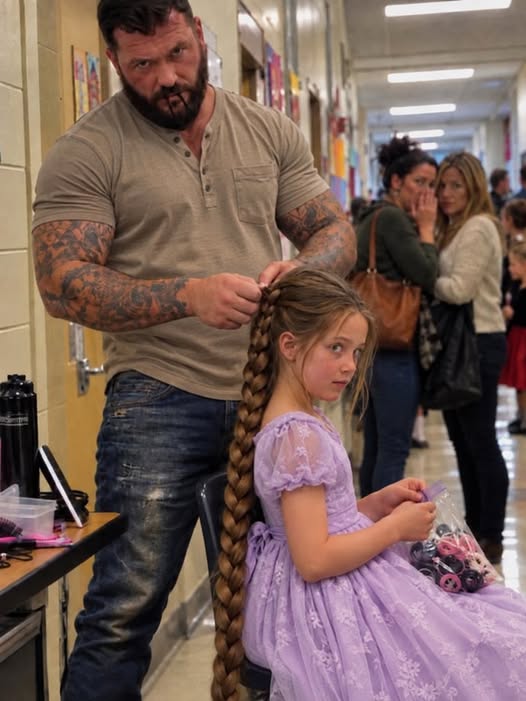
My daughter is in the same classroom as Goldie, whose hair reaches far beyond her knees.
Her father arrives early for every school event.
He comes straight from work, so he takes care of it there — bringing a small mirror from his car, sitting her in the hallway, and carefully styling her hair himself.
French braids, ribbons, pins. By the end of the evening, hardly a single strand has come loose.
Many of the parents smile…
Look at that dad. Plenty of fathers cannot even manage one braid.
And every time, I watch them and quietly wonder.
It isn’t about whether her hair looks lovely.
It’s about how challenging it seems for her.
The braid catches against her chair. During PE she holds it in one hand. Once I watched her gather the entire length in her fist in the cafeteria simply so she could lean toward her plate.
She’s nine. I’m a mother. I notice that and wonder — why?
At the school concert, everyone was gathered in the corridor waiting for the auditorium doors to open.
He stood beside the window, braiding as always.
When he finished, she rushed down the corridor toward the girls who were already dressed in their costumes.
Then one of the mothers said something. Not softly. Everyone nearby heard.
“”Someone should have taken that child to a proper hairdresser years ago.””
He focused on putting away the pins. “”Thank you, we manage.””
“”That’s not the point. Look at her. She carries that around like a backpack.””
Then another mother spoke up. “”You can tell she’s uncomfortable. That’s not devotion anymore, that’s something different.””
A third spoke more gently, although everyone still heard. “”Maybe you’re the one having trouble letting go of something, and she’s the one carrying it.””
That was when he finally straightened up.
And that was when we realized she had returned and was silently standing behind us.
She walked through our little group and placed herself directly in front of her father right there.
“”Don’t talk to my dad like that,”” she said.
Then she spoke more quietly, enough for those nearest to hear while everyone else leaned closer too: “”He cries when he brushes it. I asked him to cut it, and he said we have to wait until I’m seventeen.””
And that was the first time we watched his calm expression change for just a moment.
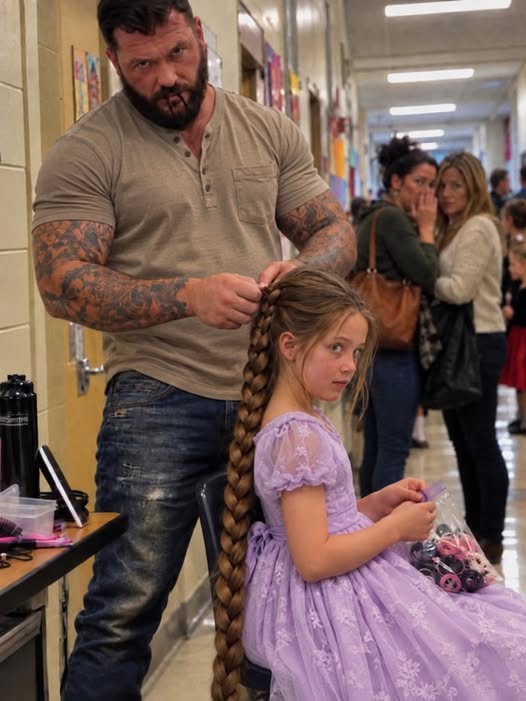
For a few seconds, Goldie’s father did not move. His fingers remained curled around the little black case where he kept her ribbons and pins, but his face had gone completely still. The corridor, noisy only moments earlier, seemed to shrink around us. Parents stopped checking their phones. Children stopped whispering. Even the woman who had made the first remark lowered her eyes as Goldie looked up at him.
Her father’s name was Noah Mercer. Until that evening, I knew almost nothing about him except that he worked long hours, drove an old dark-blue pickup truck, arrived early to every school function, and somehow knew how to create hairstyles more complicated than anything I could manage on my own daughter. He was quiet, polite, and almost impossible to draw into conversation. That night, however, silence no longer protected him.
Goldie reached for his hand. “Dad?”
Noah swallowed and looked toward the auditorium doors.
“We should get you ready,” he said.
Goldie did not move.
One of the mothers shifted uncomfortably. “We didn’t mean to upset her.”
Goldie turned around. “You didn’t upset me.”
Her voice was so steady that it made the adults seem childish.
“You upset him.”
Noah closed his eyes for half a second. Then he knelt so his face was level with hers.
“Goldie,” he whispered, “this isn’t the place.”
“Then where is the place?”
That question changed everything.
I saw it happen in Noah’s expression. Something inside him seemed to collapse, not dramatically, not with tears or shouting, but with the quiet defeat of a person who had spent years carrying something alone and had just realized the child beside him was carrying part of it too.
Goldie touched the end of her braid.
“I don’t want it anymore.”
Noah looked at her hair.
Then he looked at her.
“I know.”
The mother who had criticized him first blinked. “Then why on earth—”
“Please,” Noah said.
He did not raise his voice.
But everyone stopped.
He stood slowly and placed the case of pins inside his worn work bag. Goldie’s braid almost touched the floor behind her. The hallway lights reflected along its golden-brown length, beautiful in the way things can be beautiful from far away while being exhausting to carry.
“After the concert,” Noah said to his daughter. “We’ll talk.”
“You always say later.”
His face tightened.
“I know.”
Then the auditorium doors opened.
Teachers began waving students toward the backstage entrance, and the strange little circle around Noah broke apart. Goldie hesitated before running toward her class. Noah remained beside the window until she disappeared.
Nobody knew what to say to him after that.
Most of us simply went inside.
I sat beside my husband three rows from the front, but I barely heard the opening song. My eyes kept drifting toward Noah. He sat alone at the end of the second row, still wearing his gray mechanic’s uniform beneath a borrowed-looking jacket.
During every performance, he watched Goldie.
Only Goldie.
When the fourth-grade choir walked onto the stage, the audience lifted phones.
Goldie stood in the center.
Her braid had been looped twice around her waist so it would not drag behind her.
The children began singing.
Halfway through the song, Goldie missed a line.
No one else would have noticed.
Noah did.
He leaned forward.
Goldie’s eyes were fixed beyond the stage lights, directly on him.
For the final verse, she did not sing at all.
She simply stared.
Afterward, the applause was enormous.
Goldie bowed with the other children.
Then she did something that was not part of the program.
She stepped toward the microphone.
Her teacher reached for her shoulder, but Goldie was already speaking.
“My dad says promises are important.”
The auditorium went quiet.
Noah stood.
“Goldie.”
She looked toward him.
“He says if you promise somebody something, you don’t stop just because it gets hard.”
Her teacher whispered something, but Goldie shook her head.
“So I want to tell him something.”
Every phone in the room seemed to rise at once.
Noah stepped into the aisle.
“Sweetheart, please.”
Goldie’s chin trembled.
“I release you.”
Several parents glanced at one another.
I heard someone whisper, “Release him from what?”
Noah froze.
Goldie continued.
“Mommy’s promise.”
Something changed in his face.
Not grief.
Fear.
It was so quick I almost convinced myself I had imagined it.
Then Noah walked quickly toward the stage.
The music teacher gently guided Goldie away from the microphone, and the principal announced the next performance with the strained cheerfulness adults use when pretending something unusual has not just happened.
Goldie disappeared backstage.
Noah disappeared after her.
For the rest of the concert, his seat remained empty.
By Monday morning, everyone had heard some version of the story.
Parents speculated.
Teachers avoided discussing it.
Children, being children, invented explanations far more dramatic than anything the adults could imagine.
Goldie said nothing.
She came to school with the same enormous braid.
But something had changed.
Instead of walking into class beside her father, she walked ahead of him.
Three steps.
Not enough to look like anger.
Enough to look like distance.
That afternoon, I was waiting near the pickup lane when Noah approached me.
“Mrs. Carter?”
I turned.
He looked exhausted.
“Yes?”
“You were there Friday.”
It was not a question.
“I was.”
He glanced toward the school doors.
“Did you hear what Goldie said before the concert?”
I hesitated.
“Yes.”
“All of it?”
“Enough.”
His jaw tightened.
“I need a favor.”
I expected him to ask me not to repeat what I had heard.
Instead, he said, “If she ever tells your daughter she wants to cut her hair, please tell me.”
I stared at him.
“She already told you.”
“Yes.”
“Then why would she need to tell my daughter?”
His eyes shifted toward the doors again.
“Because she might stop telling me.”
That answer stayed with me.
Before I could respond, Goldie appeared with my daughter, Emma.
They were laughing about something.
The moment Goldie saw her father, the laugh vanished.
Noah noticed.
He smiled anyway.
“Ready?”
Goldie nodded.
Emma hugged her goodbye.
As they walked toward his truck, Goldie’s braid dragged across the back of her coat until Noah gently lifted it and placed it over her arm.
She took it from him without looking at his face.
Two days later, my daughter came into the kitchen while I was making dinner.
“Mom?”
Something in her voice made me put down the knife.
“What happened?”
“Goldie told me a secret.”
I waited.
Emma twisted the sleeve of her sweatshirt.
“She said I’m not allowed to tell.”
“Is somebody hurting her?”
“I don’t think so.”
“Is she afraid?”
Emma considered that.
“Yes.”
My heart began beating faster.
“Afraid of what?”
“She doesn’t know.”
That was somehow worse.
Emma sat at the kitchen table.
“She said her dad has a box under his bed.”
I remained standing.
“What kind of box?”
“She doesn’t know. But once she went into his room looking for batteries and he got really mad because she was near it.”
“Did she open it?”
“No.”
Emma looked toward the hallway as if Goldie might somehow be listening.
“She said there’s a picture of her mom taped to the top.”
That seemed ordinary enough.
Until Emma added the next part.
“And there’s hair inside.”
I sat down.
“What?”
“She saw it when the lid moved.”
“Hair like a lock of hair?”
Emma shook her head.
“A braid.”
I felt a chill move through me.
“How long?”
“She doesn’t know. Long.”
I tried to keep my expression neutral for my daughter.
“Did Goldie say anything else?”
Emma nodded.
“She said her dad told her never to touch it because it belongs to her mother.”
That evening, I told my husband.
He was less alarmed than I was.
“A man keeps his dead wife’s braid,” he said. “Strange, maybe. But grief makes people strange.”
“We don’t know that she’s dead.”
He looked at me.
I realized neither of us had ever heard anyone actually say Goldie’s mother was dead.
We had assumed it.
Noah never mentioned her.
Goldie never mentioned visiting her.
Whenever school forms asked for parents, Noah’s name was the only one listed.
People see an absent mother and a father who cries while brushing his daughter’s hair, and they build the story themselves.
Widower.
Tragedy.
Promise.
Grief.
Not one of us had asked whether that story was true.
The next afternoon, I made what I told myself was a harmless search.
I typed Noah Mercer’s name into my phone.
There were several people with the same name.
Then I added our town.
Nothing.
I added Goldie.
Nothing.
Finally, I searched the name printed on his mechanic’s uniform along with his surname.
A five-year-old newspaper article appeared.
The headline made my stomach turn.
LOCAL WOMAN MISSING; HUSBAND QUESTIONED.
I opened it.
The photograph loaded slowly.
A young woman stared back at me.
Her name was Evelyn Mercer.
Twenty-eight years old.
Missing for nearly six years.
Last seen leaving her home on a rainy October night.
Her husband, Noah Mercer, had reported her missing the following morning.
Police had questioned him but never charged him.
Their three-year-old daughter had been inside the home.
Goldie.
I read the article twice.
Then a third time.
The report said Evelyn’s purse had been found in her car at a bus terminal thirty miles away.
Her phone had never been recovered.
There had been no confirmed sightings after that night.
No body.
No arrest.
No explanation.
Near the end of the article was one sentence that made me sit back.
According to relatives, Evelyn Mercer was known for her extremely long hair, which reached below her waist.
The photograph suddenly looked different.
I enlarged it.
Evelyn’s hair was nearly the same shade as Goldie’s.
That night I did not tell Emma what I had found.
I did not tell another parent.
But I could not stop thinking about the braid in the box.
Three days later, the school counselor called me.
Not because of Noah.
Because of Goldie.
Goldie had cut a piece of her own hair during art class.
Not much.
About four inches from the end.
But when Noah arrived to collect her, his reaction frightened the teacher.
He did not shout.
He did not threaten anyone.
He simply picked up the severed piece from the counselor’s desk and stared at it until his hands began shaking.
Then he asked who had done it.
Goldie said, “I did.”
According to the counselor, Noah had turned white.
He crouched in front of her.
“Why?”
“Because it’s mine.”
He had no answer.
That evening, Goldie came home with us.
It was the first time she had ever visited our house.
Noah had an emergency shift at work, and because Goldie and Emma were close, he reluctantly agreed to let her stay until eight.
At dinner, Goldie seemed like any other nine-year-old.
She laughed too loudly.
She put ketchup on food that absolutely did not require ketchup.
She argued with Emma about which movie to watch.
Then, while the girls were making popcorn, her braid caught around a drawer handle.
Goldie jerked backward.
The drawer flew open.
A bowl shattered.
Goldie immediately dropped to her knees.
“I’m sorry.”
“It’s okay,” I told her.
She started gathering broken pieces with her bare hands.
I stopped her.
“Goldie, leave it.”
“I can fix it.”
“It’s just a bowl.”
Her eyes filled.
“It was because of my hair.”
I knelt beside her.
“Accidents happen.”
She looked down at the braid.
“I hate it.”
There was no drama in the words.
That made them heavier.
“Does your dad know?”
“Yes.”
“Have you told him how much?”
“Yes.”
I chose my next words carefully.
“Why does he say seventeen?”
Goldie stared at me.
“I don’t know.”
“You said something about your mother’s promise.”
“That’s what he calls it.”
“What did she promise?”
“No. He promised her.”
My breathing slowed.
“What did he promise?”
Goldie whispered, “Not to cut my hair until she came back.”
For a moment I could hear only the microwave fan above the stove.
“Until she came back?”
Goldie nodded.
“But you said seventeen.”
“He changed it.”
“When?”
“Last year.”
“Why?”
Goldie looked toward the living room, checking that Emma was not nearby.
“Because I asked what happens if Mom never comes back.”
My throat tightened.
“What did he say?”
“He got sad.”
She pulled the braid into her lap.
“Then he said when I’m seventeen, I can decide everything for myself.”
That sounded almost reasonable.
Almost.
Except Goldie was nine.
And deciding whether to cut her own hair was not something that should require eight more years.
At eight fifteen, headlights moved across our kitchen wall.
Noah was early.
Goldie immediately stood.
When he entered, he thanked us three times.
Then he noticed the broken bowl.
His expression changed.
“What happened?”
Goldie touched her braid.
“My hair caught it.”
Noah looked at me.
“It’s fine,” I said.
He nodded.
Goldie put on her coat.
As Noah lifted her braid away from the zipper, she stepped sideways.
“I can do it.”
His hand stopped.
“Okay.”
She tucked the braid inside the coat herself.
Before leaving, Noah turned toward me.
“Thank you.”
Something about his expression made me speak.
“Noah.”
He waited.
“She told me about Evelyn.”
Every muscle in his face tightened.
Goldie looked between us.
“You told her?”
“I only said the promise.”
Noah closed his eyes.
When he opened them, he looked at me.
“Can we not do this in front of her?”
Goldie folded her arms.
“You always say that.”
“Goldie.”
“You said we’d talk after the concert.”
“We did.”
“No. You talked.”
Noah looked as if she had struck him.
Goldie continued.
“You said Mom loved my hair and you promised to keep it safe.”
“She did.”
“You said cutting it would mean giving up.”
His voice dropped.
“I shouldn’t have said that.”
“But you did.”
“I know.”
Goldie’s eyes filled with tears.
“So if I cut it, you’ll think I gave up on Mom.”
“No.”
“You will.”
“No.”
She pointed toward his work bag.
“You kept the piece from school.”
Noah said nothing.
Goldie looked at me.
“He keeps everything.”
Then she walked outside.
Noah stood in my kitchen, staring at the open door.
After a moment, I said, “You need to let her cut it.”
He did not look at me.
“I know.”
I was not expecting that answer.
“Then why don’t you?”
His hand moved over his face.
“Because I’m a coward.”
That was the first completely honest thing I had heard him say.
He sank into a kitchen chair.
For a long time he stared at the floor.
Then he spoke.
“The night Evelyn disappeared, she cut her hair.”
I stopped breathing.
Noah looked up.
“The braid in the box is hers.”
I said nothing.
“She had hair almost to her knees when we met. Goldie inherited it. Same texture. Same color. Evelyn loved it for years.”
His voice became distant.
“Then one night she cut it off.”
“Why?”
“I don’t know.”
“You never asked?”
“I wasn’t there when she did it.”
He rubbed his palms against his jeans.
“I came home from a late shift. Goldie was asleep. Evelyn’s braid was sitting on the bathroom counter.”
“And Evelyn?”
“Gone.”
I felt the room tilt slightly.
“The same night?”
“Yes.”
“Did she leave a note?”
Noah hesitated.
That hesitation told me there was more.
“Noah.”
“There was a note.”
“What did it say?”
His face hardened.
“That’s where people get this story wrong.”
“What story?”
“That she just disappeared.”
He looked toward the window where Goldie waited beside his truck.
“She left.”
I stared at him.
“The police article said—”
“I know what the article said.”
“Then why was she classified as missing?”
“Because nobody could find her.”
He leaned forward.
“But Evelyn chose to walk out of that house.”
“How do you know?”
“Because the note said so.”
I waited.
Noah swallowed.
“She wrote, ‘Do not look for me. Take care of Goldie. Do not let them cut her hair. I will come back before she understands.’”
The words sounded so strange that I asked him to repeat them.
He did.
“Who is ‘them’?”
“I don’t know.”
“You’ve had six years to find out.”
His eyes flashed.
“You think I haven’t tried?”
I immediately regretted my tone.
He stood.
“I spent everything I had for the first two years. Investigators. Lawyers. Searches. I chased every rumor. Every phone call. Every woman someone thought looked like her.”
“Why didn’t police believe the note?”
“They did.”
“Then why question you?”
“Because husbands are questioned.”
He gave a humorless laugh.
“And because Evelyn had told her sister we were arguing.”
“Were you?”
“Yes.”
“About what?”
Noah looked toward Goldie again.
“Her family.”
Before I could ask more, he opened the door.
Then he stopped.
“The seventeen thing isn’t Evelyn’s rule.”
“I know.”
“That was me.”
He looked ashamed.
“I thought giving Goldie a date would make it easier than telling her I still wake up every morning thinking maybe today is the day her mother walks through the door.”
Then he left.
For two weeks, nothing happened.
Then Evelyn Mercer walked into the school office.
I was not there.
But by lunchtime, every adult in the building knew.
She arrived at eleven thirty-seven on a Tuesday wearing a camel coat, dark trousers, and hair cut just above her shoulders.
The secretary later said she recognized her immediately from old photographs.
Evelyn asked one question.
“Is Goldie Mercer here?”
The principal called Noah before bringing Goldie down.
Noah arrived in twelve minutes.
When he entered the office and saw Evelyn, he stopped so suddenly that the school secretary thought he might faint.
Evelyn stood.
Neither spoke.
Then Goldie came through the counselor’s door.
She looked first at her father.
Then at the woman.
The adults waited for recognition.
There was none.
Goldie had been three when her mother vanished.
Evelyn began crying.
Goldie moved closer to Noah.
“Who is she?”
Noah’s mouth opened.
Nothing came out.
Evelyn answered.
“I’m your mother.”
Goldie stared at her.
Then at her short hair.
According to the counselor, that was the first thing she noticed.
“You cut it.”
Evelyn touched the ends unconsciously.
“Yes.”
Goldie looked up at Noah.
The betrayal on her face was so complete that everyone in the office understood what she was thinking before she said it.
“You said she loved long hair.”
Noah whispered, “She did.”
Goldie turned back to Evelyn.
“Do you?”
Evelyn shook her head.
“No.”
One word.
Six years of belief shattered by one word.
Goldie stepped backward.
Noah reached for her.
She pulled away.
Then Evelyn saw Goldie’s braid.
Her entire face changed.
Not sadness.
Horror.
She walked forward.
“Oh my God.”
Noah moved between them.
“Don’t.”
Evelyn looked at him.
“You kept it?”
His expression hardened.
“You told me to.”
“I told you—”
She stopped.
The principal looked from one to the other.
“Told him what?”
Evelyn’s eyes filled with fear.
She grabbed her handbag.
“I shouldn’t have come here.”
Noah stared at her.
“You don’t get to do that.”
“I made a mistake.”
“You disappeared for six years.”
“I know.”
“You let your daughter think you were dead.”
“I know.”
“You left one note.”
“I know.”
“Then explain it.”
Evelyn glanced toward Goldie.
“Not here.”
Goldie suddenly shouted.
“Stop saying that!”
Everyone froze.
She was crying now.
“Everybody keeps saying not here, not now, when you’re older, when you understand.”
Her small hands grabbed her braid.
“I understand this hurts!”
Evelyn covered her mouth.
Goldie lifted the braid with both hands.
“I hate this thing!”
She turned toward Noah.
“You told me Mom wanted it.”
Then toward Evelyn.
“And you don’t even want it!”
“No,” Evelyn said quickly. “Goldie, I never wanted this for you.”
Goldie stared at her father.
Noah looked destroyed.
“You wrote it,” he whispered to Evelyn.
Evelyn shook her head.
“No.”
Noah went completely still.
“What?”
“I didn’t write that.”
The room seemed to lose sound.
Noah stared at her.
“I have the note.”
“I wrote a note.”
“You wrote those words.”
“I wrote three words.”
Noah’s face drained of color.
Evelyn stepped backward.
“My note said, ‘I’m sorry, Noah.’”
Nobody moved.
Noah whispered, “That’s not possible.”
“It is.”
“I found it on the kitchen table.”
Evelyn shook her head slowly.
“Noah, I left my note in your lunch box.”
His expression changed.
“What?”
“You were working nights. You always packed lunch before leaving. I put it under the napkin because I knew you wouldn’t see it until your break.”
Noah looked as though the floor had vanished beneath him.
“The note on the table—”
“Wasn’t mine.”
The principal immediately told the secretary to take Goldie into another room.
Goldie refused.
“I’m staying.”
Noah was staring at nothing now.
Six years of memory were rearranging themselves behind his eyes.
Evelyn stepped closer.
“That’s why I came back.”
He looked at her.
“What do you mean?”
“I saw the concert video.”
Someone had uploaded Goldie’s microphone speech.
It had spread through local social media.
One clip had reached nearly half a million views.
Evelyn had seen it four states away.
She had recognized the school.
She had recognized Noah.
And then she had recognized the hair.
“I knew someone had given you the message,” she said.
Noah’s voice cracked.
“What message?”
“The one I spent six years running from.”
Evelyn turned toward the principal.
“I need police.”
The principal hesitated.
Noah stared at her.
“Evelyn.”
She looked directly at him.
“The note wasn’t for you.”
Silence.
“It was for me.”
Within an hour, two detectives arrived.
By evening, the story we thought we understood had disappeared completely.
Evelyn had not left Noah because of him.
She had left because of her mother.
Goldie’s grandmother.
Her name was Miriam Vale.
None of us had heard the name before.
Noah had.
He hated it.
Evelyn grew up in a religious commune two counties north of us, a place called Shepherd’s Hollow.
Its members lived mostly apart from the surrounding town.
Girls were expected to keep their hair uncut.
Women covered it in public.
Leaving the community meant losing contact with nearly everyone inside.
Evelyn left at seventeen.
That was the first twist.
Seventeen had never been Goldie’s age.
It was Evelyn’s.
For years, Noah had repeated that number without understanding why it felt so important to him.
It was the age Evelyn had escaped.
The age she had cut her hair for the first time.
The age she had met the outside world.
And the age her mother had promised she would regret leaving.
Noah knew some of this.
Not all.
Evelyn had told him her childhood was strict.
She had never told him how frightening it had been.
When Goldie was born, Miriam contacted Evelyn.
At first, the messages sounded harmless.
Congratulations.
Blessings.
Requests for photographs.
Then came questions about Goldie’s hair.
How quickly was it growing?
Had they trimmed it?
Was Evelyn raising her correctly?
Evelyn stopped responding.
Miriam began appearing outside their house.
Noah remembered seeing her twice.
He thought she was simply an overbearing mother trying to reconcile.
Evelyn knew better.
She also knew something Noah did not.
Miriam believed Goldie belonged to Shepherd’s Hollow.
Not legally.
Spiritually.
And in Miriam’s mind, that distinction did not matter.
When Goldie was two, Evelyn found one of Miriam’s followers standing beside Goldie’s window.
They fled before police arrived.
After that, Evelyn became terrified.
She changed locks.
Closed curtains.
Stopped taking Goldie to parks alone.
Noah thought she was becoming paranoid.
They argued.
Evelyn told him he did not understand her family.
Noah told her she could not spend the rest of her life afraid.
Both believed they were protecting Goldie.
Neither understood how close the danger had already come.
Then, shortly before Evelyn disappeared, an envelope arrived.
Inside was a photograph of three-year-old Goldie leaving daycare.
On the back were seven words.
SHE WILL RETURN BEFORE SHE BECOMES LIKE YOU.
Evelyn panicked.
She made a decision that would destroy her family for six years.
She planned to leave temporarily.
Not forever.
She believed Shepherd’s Hollow was watching her.
So she intended to disappear, draw whoever was following her away from Goldie, contact authorities outside the county, and return once she knew her daughter was safe.
She cut her hair because it made her instantly less recognizable.
She changed clothes.
She left her car at the bus terminal.
And she placed a three-word apology inside Noah’s lunch box.
But before she left, someone entered the house.
That person left another note.
“Do not look for me. Take care of Goldie. Do not let them cut her hair. I will come back before she understands.”
Noah found that note first.
Hours later, when he discovered Evelyn missing, he never checked the bottom of his lunch box.
By the time he did, days had passed.
He found nothing.
Because someone had already removed Evelyn’s real note.
The detectives asked the obvious question.
Who had been inside the house?
Noah thought for a long time.
Then he whispered one name.
“Rachel.”
Evelyn’s sister.
Rachel Vale lived only fifteen minutes away.
She had comforted Noah after Evelyn disappeared.
She helped organize searches.
She spoke to reporters.
She told police that Noah and Evelyn had been arguing.
She testified that Evelyn had seemed frightened during the final weeks of her marriage.
She was the primary reason detectives initially looked so closely at Noah.
And for six years, she called every month to ask how Goldie was doing.
Sometimes she brought birthday presents.
Sometimes she attended school plays.
Sometimes she stood in the back of the room and watched Noah braid Goldie’s hair.
I remembered her immediately when I saw the photograph.
A tall woman with dark hair.
She had been at the concert.
Standing near the auditorium doors.
Watching.
The police went to Rachel’s home that evening.
She was gone.
Her closets were half empty.
Her phone was disconnected.
And on her kitchen counter they found a printed screenshot from the viral concert video.
Goldie stood at the microphone.
Her enormous braid was visible over her shoulder.
Someone had circled it in red ink.
Underneath were four handwritten words.
SHE IS ALMOST READY.
Noah read those words at the police station.
Then he asked Evelyn a question.
“Ready for what?”
Evelyn began to cry.
She did not want to answer in front of Goldie.
This time, Goldie did not argue.
She was exhausted.
A counselor took her to another room with coloring books and hot chocolate.
Only then did Evelyn explain.
In Shepherd’s Hollow, girls did not cut their hair before a ceremony performed shortly before adolescence.
The community called it the Binding.
The hair represented obedience to family authority.
After the ceremony, the girl’s mother or grandmother braided it publicly.
For Evelyn, the Binding had been the moment she understood she was expected to remain in the community permanently.
She fled several years later.
Miriam had never forgiven her.
“You thought they wanted Goldie’s hair,” Noah said.
“No.”
Evelyn shook her head.
“They wanted Goldie.”
Noah looked physically sick.
“And you left her with me?”
“I thought you were the safest person she had.”
“You disappeared!”
“I was supposed to be gone for three days.”
“Six years, Evelyn.”
Her face collapsed.
“I know.”
“What happened?”
That answer was even worse.
Evelyn had reached a women’s shelter two states away and contacted a former member of Shepherd’s Hollow who had helped others leave.
The woman agreed to help Evelyn document Miriam’s threats.
Before they could meet, the woman vanished.
Evelyn panicked again.
She believed her mother’s people had found her.
So she ran farther.
She changed her surname.
Worked under temporary jobs.
Avoided social media.
Every few months, she tried to find information about Noah and Goldie without contacting them directly.
Then she made a discovery.
Online news archives contained articles implying Noah might have been responsible for her disappearance.
Rachel had been quoted in several.
Evelyn thought contacting Noah could make police arrest him or reveal where she was hiding.
Fear distorted everything.
Weeks became months.
Months became years.
She told herself Goldie was safer without her.
Then shame made returning harder.
By the time she understood she had made an unforgivable mistake, she had no idea how to explain it.
So she watched from a distance.
Until the concert video appeared.
Until she heard Goldie say seventeen.
Until she saw the braid.
That was when Evelyn realized Rachel had never simply suspected where Goldie was.
Rachel had been guiding Noah all along.
Every year, she reinforced the story.
Evelyn loved her hair.
Evelyn would want Goldie to keep hers.
Maybe don’t cut it yet.
It would mean so much if she came home and saw Goldie looking like her.
Noah, grieving and guilty, listened.
Rachel never needed to order him.
She only needed to keep the promise alive.
The most terrifying manipulation is not the kind that forces you.
It is the kind that makes you believe the choice was yours.
Police found Rachel two days later.
She had driven north.
Toward Shepherd’s Hollow.
They stopped her less than twenty miles from the community.
In her vehicle were photographs of Goldie.
School schedules.
Concert programs.
A copy of Noah’s work shifts.
And several handwritten letters from Miriam Vale.
One letter was dated six years earlier.
It contained a sentence investigators later showed Noah.
KEEP THE CHILD UNALTERED. EVELYN MAY RUN, BUT BLOOD RETURNS TO BLOOD.
Noah read it once.
Then handed it back.
He did not speak for nearly ten minutes.
Rachel was arrested on charges connected to stalking, unlawful surveillance, evidence tampering, and conspiracy tied to the years-long harassment.
Investigators reopened Evelyn’s disappearance case from the beginning.
She was no longer considered a missing person.
She was now a witness.
But the story was not over.
Because Miriam was missing.
When police entered Shepherd’s Hollow, they found only twenty-three residents.
Miriam was not among them.
Her bedroom had been cleared out.
Several vehicles were gone.
And in a locked cabinet inside the main meeting hall, detectives found photographs.
Dozens.
Girls.
Women.
Families.
Some were former members.
Some were children of former members.
Goldie had her own folder.
The first photograph showed her at eighteen months.
The most recent had been taken three weeks before the concert.
Noah standing outside school.
Goldie beside him.
Her braid clearly visible.
On the back someone had written one word.
SEVENTEEN.
When Noah learned about the photograph, something finally broke.
Not loudly.
He drove home, walked into his bedroom, pulled the wooden box from beneath his bed, and placed it on the kitchen table.
Goldie watched from the doorway.
Evelyn stood near the sink.
Nobody touched the box.
Noah opened it.
Inside were six years of grief.
Evelyn’s braid.
The false note.
Newspaper clippings.
Printed photographs.
Birthday cards Goldie had made for a mother she barely remembered.
Tiny pieces of ribbon.
And the four inches of Goldie’s hair she had cut in art class.
Goldie saw it.
Her face changed.
Noah picked up the small lock.
“I’m sorry.”
She stared at him.
“I shouldn’t have kept this.”
He placed it in the trash.
Goldie looked surprised.
Then Noah lifted the false note.
His hands shook.
“For six years, I thought your mom wrote this.”
Evelyn stood silently across the room.
“I thought keeping your hair meant keeping a promise.”
Goldie asked, “To her?”
Noah looked at the paper.
“No.”
Then he tore it in half.
“To somebody who wanted us to believe it was her.”
He tore it again.
And again.
Until the message that had controlled six years of their lives became scraps.
Goldie watched every piece fall.
Then she looked at the braid inside the box.
Her mother’s braid.
“What about that?”
Noah could not answer.
Evelyn walked forward.
She touched it.
For years, Noah had imagined that moment.
He thought she would cry.
Smile.
Remember.
Instead, Evelyn picked up the braid and stared at it with something close to disgust.
“I cut this because I wanted to be free.”
Noah looked at her.
She continued.
“And somebody turned it into a chain for our daughter.”
That sentence destroyed the last excuse.
Goldie whispered, “Can I cut mine?”
Noah looked at Evelyn.
Evelyn looked at Noah.
Then both looked at Goldie.
Noah knelt.
“You never needed permission.”
Goldie’s face tightened.
“Yes, I did.”
He closed his eyes.
She was right.
For years, he had told her otherwise.
Noah nodded slowly.
“You’re right.”
He forced himself to meet her eyes.
“I made you believe you needed my permission. You didn’t.”
Goldie touched the braid.
“So I can?”
“Yes.”
“Today?”
His voice broke.
“Yes.”
“Now?”
Noah smiled through tears.
“If you want.”
Goldie did.
But she did not go to a salon.
She asked for something else.
“Can Mrs. Carter do it?”
When Noah called me, I thought something terrible had happened.
He asked if I still owned the hair scissors I had once mentioned using on Emma’s bangs.
I said yes.
Twenty minutes later, they were standing in my kitchen.
Noah.
Goldie.
Evelyn.
The strangest family reunion I had ever witnessed.
Goldie climbed onto the same chair where she had sat after breaking my bowl weeks earlier.
Her braid rested on the floor behind her.
I wrapped a towel around her shoulders.
“How short?”
She looked at herself in the mirror.
“Here.”
She pointed just above her shoulders.
Noah inhaled sharply.
Goldie heard him.
She turned.
“You okay?”
He nodded.
Then stopped.
“No.”
Goldie waited.
“I’m scared.”
“Of what?”
He looked at the braid.
“That I’ll feel like I lost your mom again.”
Evelyn’s eyes filled.
Goldie considered this.
Then she said something I will remember for the rest of my life.
“But she’s standing right there.”
Noah looked at Evelyn.
For six years, he had preserved a version of her.
Long hair.
Young face.
Missing wife.
Frozen memory.
The woman standing in my kitchen was different.
Older.
Short-haired.
Exhausted.
Complicated.
Alive.
Noah began crying.
Not quietly.
He covered his face.
Goldie got down from the chair and hugged him.
Her braid pooled around both of them.
“I’m not Mom,” she whispered.
“I know.”
“You don’t have to keep me looking like her.”
“I know.”
“You promise?”
Noah lowered his hands.
This time, he understood the danger of promises.
So he answered differently.
“I’ll try every day.”
Goldie nodded.
“That’s better.”
She climbed back onto the chair.
I tied three bands around the braid.
One near her neck.
One in the middle.
One near the bottom.
My hands were shaking so badly that Evelyn finally took the scissors from me.
“Maybe I should.”
Goldie looked at her.
For the first time since Evelyn returned, something warm passed between them.
“You know how?”
Evelyn gave a tiny smile.
“I’ve done it once.”
Goldie understood.
She smiled too.
Evelyn positioned the scissors above the top band.
Noah stepped closer.
Goldie watched him in the mirror.
“You can leave if you want.”
He shook his head.
“No.”
The blades closed.
Nothing happened at first.
There was too much hair.
Evelyn opened the scissors and tried again.
A thick section separated.
Noah flinched.
Another cut.
Then another.
Finally, the braid came free.
It landed heavily in Evelyn’s hands.
Goldie’s head tipped forward from the sudden loss of weight.
She blinked.
Then lifted her face.
Her remaining hair barely touched her shoulders.
She moved her head left.
Then right.
A laugh escaped her.
“I feel weird.”
Emma, who had been watching from the doorway, grinned.
“You look awesome.”
Goldie stood.
She shook her head again.
Her hair swung around her face.
She laughed louder.
Then she began spinning in circles.
No braid struck the chair.
Nothing caught on the counter.
Nothing dragged behind her.
She ran from the kitchen to the living room.
Back again.
Then down the hallway.
Just because she could.
Noah watched her.
He was crying again.
But this time he was smiling.
Evelyn still held the severed braid.
“What do we do with this?”
Everyone looked at Goldie.
She stopped running.
For years, adults had made decisions about her hair because of what it meant to them.
Her grandmother.
Her aunt.
Her father.
Even her mother.
Now they waited.
Goldie thought carefully.
“Donate it.”
Noah smiled.
“All of it?”
“All of it.”
She looked at the enormous braid.
“If somebody wants hair this badly, they can have it.”
We laughed.
Even Evelyn.
Especially Evelyn.
For one evening, it felt as though the story had finally reached its ending.
It had not.
Three nights later, somebody broke into Noah’s house.
Nothing valuable was taken.
The television remained.
Cash remained in a drawer.
Goldie’s tablet was untouched.
The intruder went directly to Noah’s bedroom.
The wooden box was opened.
Evelyn’s braid was gone.
The police arrived before midnight.
Noah stood in the hallway while an officer photographed the window.
Goldie sat wrapped in a blanket.
Evelyn stared at the empty box.
Then Noah’s phone rang.
Unknown number.
A detective told him not to answer.
The phone stopped.
Then a voicemail appeared.
Noah played it on speaker.
At first there was only breathing.
Then an elderly woman spoke.
“You cut what was not yours to cut.”
Evelyn went pale.
“Miriam.”
Goldie looked at her.
The message continued.
“You were warned once, Evelyn. You will not be warned again.”
The voicemail ended.
Noah stared at the phone.
The detective immediately began tracing the call.
Evelyn sat beside Goldie.
Her hands trembled.
Goldie looked strangely calm.
Perhaps children reach a point where adults’ secrets stop shocking them.
She leaned against Evelyn.
“So Grandma is crazy?”
Noah almost laughed despite everything.
Evelyn answered carefully.
“She believes things that make her dangerous.”
Goldie nodded.
“Okay.”
Then she asked the question nobody expected.
“Why does she care about hair so much?”
Evelyn stared at the floor.
“Because in Shepherd’s Hollow, hair was used to show who obeyed.”
Goldie touched her new short haircut.
“So this means I don’t?”
Evelyn looked at her.
“Yes.”
Goldie smiled.
“Good.”
Police found Miriam four days later.
She was staying in a farmhouse owned by a former Shepherd’s Hollow member.
Rachel had contacted her after the concert video went viral.
The break-in, however, had not been Miriam.
It had been Rachel’s nineteen-year-old son.
Goldie’s cousin.
A boy Noah had met at family gatherings.
A boy who had played board games with Goldie.
A boy nobody had suspected.
He admitted taking Evelyn’s braid.
Miriam had demanded it.
When police searched the farmhouse, they found the braid placed beside a photograph of Goldie.
For Noah, that was the final betrayal.
Not because the braid mattered anymore.
Because he finally understood how many ordinary people had quietly helped Miriam keep control.
Not monsters.
Not strangers hiding in shadows.
Relatives.
Friends.
People who smiled at birthdays.
People who offered help.
People who told him they understood his grief.
Miriam was arrested.
The investigation into Shepherd’s Hollow widened.
Former members came forward.
Some described coercive rules.
Others defended the community and insisted outsiders misunderstood their traditions.
Authorities focused not on beliefs, but on documented stalking, threats, trespassing, and attempts to control former members.
For the first time in years, Evelyn stopped running.
That did not mean she came home.
Noah did not ask her to.
Goldie did not suddenly call her Mom every five minutes.
Real life refused to behave like the final scene of a movie.
Evelyn rented a small apartment nearby.
She attended counseling with Goldie.
Sometimes their meetings went beautifully.
Sometimes Goldie refused to speak.
Sometimes she asked Evelyn a hundred questions.
Sometimes only one.
“Why didn’t you come back?”
Evelyn never invented a pretty answer.
“I was scared.”
Another time Goldie asked, “More scared than you loved me?”
Evelyn cried.
But she answered.
“For a while, yes.”
Goldie did not forgive her immediately.
Nobody asked her to.
Noah began counseling too.
One afternoon, months later, I saw him sitting outside school with another father.
The man was struggling to put his daughter’s hair into a ponytail.
Noah laughed and showed him how.
For years, parents had praised Noah’s braids as evidence of devotion.
Now he seemed to understand something none of us had.
Love is not measured by how tightly you can hold something together.
Sometimes it is measured by whether you know when to let go.
Goldie’s short hair became old news remarkably quickly.
Children adapt faster than adults.
Within a week, nobody stared.
Within a month, some students barely remembered how long it had been.
Goldie joined soccer.
She had avoided it before because running with the braid had been difficult.
The first game Noah attended, she scored no goals.
Her team lost four to one.
Goldie came off the field covered in grass stains and smiling like she had won a championship.
Noah handed her water.
“How was it?”
She threw her arms around him.
“My head didn’t hurt once.”
He turned away for a moment.
I pretended not to notice.
A year later, the school held another concert.
I arrived early.
So did Noah.
Old habits.
But this time he carried no mirror.
No ribbons.
No pin case.
Goldie came running down the hallway with hair that barely touched her collar.
Evelyn followed several steps behind.
Their relationship was still unfinished.
Maybe it always would be.
But Goldie reached back and grabbed her hand.
That was enough.
Near the auditorium doors stood the same mother who had made the first comment the year before.
She looked uncomfortable when she saw Noah.
Eventually, she approached him.
“I owe you an apology.”
Noah shook his head.
“You saw a child struggling.”
“I judged you.”
“You did.”
The woman winced.
Noah smiled faintly.
“But you also said something I needed to hear.”
She looked confused.
“What?”
“That she was carrying something for me.”
His eyes moved toward Goldie.
“You were right.”
The woman did not know how to respond.
Neither did I.
Then Goldie called from the auditorium.
“Dad!”
Noah turned.
She waved impatiently.
“Come on!”
He followed her.
No hesitation.
No braid to pick up behind her.
No promise trailing across the floor.
Before the concert began, Goldie asked the music teacher if she could say something at the microphone.
The teacher glanced nervously toward Noah.
He laughed.
“Apparently we haven’t learned our lesson.”
Goldie stepped onto the stage.
She was ten now.
Taller.
Louder.
Far more confident.
She looked out over the parents.
“Last year I said my dad made me wait until I was seventeen to cut my hair.”
Noah covered his face.
The audience laughed gently.
Goldie grinned.
“He doesn’t anymore.”
More laughter.
Then she became serious.
“My dad thought he was keeping a promise.”
She glanced toward Evelyn.
“My mom thought running away was protecting me.”
Then toward Noah.
“They were both wrong.”
The auditorium became quiet.
Goldie touched the ends of her short hair.
“But adults can be wrong and still love you.”
Noah’s eyes filled.
“So if somebody loves you, you should still tell them when something hurts.”
No one moved.
Goldie smiled.
“And if they really love you, eventually they’ll listen.”
She returned the microphone.
The audience applauded.
Noah stood first.
Evelyn stood next.
Soon everyone was standing.
Goldie looked embarrassed.
She covered her face.
Afterward, families gathered in the corridor.
Children ran everywhere.
Parents took photographs.
Noah stood beside the same window where we had first watched him braid hair that reached below his daughter’s knees.
This time, his hands were empty.
I walked over.
“You doing okay?”
He smiled.
“Better.”
Across the corridor, Goldie was arguing with Emma about where they wanted to eat.
Evelyn stood nearby.
Noah watched them.
“Do you ever miss it?” I asked.
He knew what I meant.
“The hair?”
I nodded.
He thought for a moment.
“Sometimes.”
Then he smiled.
“But I think what I really miss is believing I understood everything.”
“That sounds uncomfortable.”
“It is.”
Goldie suddenly sprinted toward him.
“Dad, Mom says pizza, Emma says burgers, and I say tacos.”
Noah looked at Evelyn.
She shrugged.
“Your problem.”
Goldie grabbed his arm.
“No. Family vote.”
The word family made all three of them pause.
Only briefly.
Then Noah said, “Tacos.”
Goldie cheered.
Evelyn rolled her eyes.
“Traitor.”
They walked away together.
Not like the family they had been six years earlier.
Not like the family Noah had spent years waiting to restore.
Something new.
Something imperfect.
Something chosen.
I remained in the hallway and thought about how confidently we had judged them that first night.
We thought the mystery was a father refusing to cut his daughter’s beautiful hair.
We thought grief had made him selfish.
Then we thought grief had made him loyal.
Then we learned loyalty itself had been manipulated.
Every explanation had contained a piece of truth.
None contained all of it.
The most frightening person in the story had not been the father crying over a braid.
It had been the people who understood exactly what those tears meant and used them to keep his daughter carrying their rules.
Months later, Noah told me investigators had found one final item while cataloguing evidence from Miriam’s farmhouse.
It was a photograph.
Evelyn at seventeen.
The day she left Shepherd’s Hollow.
Her hair had just been cut.
It was short, uneven, and badly done.
But Evelyn was smiling.
On the back, someone had written a date.
Underneath, in Evelyn’s own teenage handwriting, were five words.
NOW I LOOK LIKE MYSELF.
Noah gave the photograph to Goldie.
She taped it beside her bedroom mirror.
Not because she wanted to look like her mother.
That was the whole point.
One morning before school, Noah found Goldie standing in front of it.
She was brushing her shoulder-length hair, which had begun growing again.
He leaned against the doorway.
“You letting it grow?”
“A little.”
He smiled.
“How long?”
Goldie shrugged.
“Until I don’t want it long anymore.”
Noah nodded.
No argument.
No promise.
No age.
Goldie looked at him through the mirror.
“If I grow it to my knees again, will you braid it?”
He laughed.
“If you ask me.”
“And if I cut it tomorrow?”
“I’ll sweep the floor.”
She smiled.
That was when Noah finally understood what the promise should have been all along.
Not that Goldie would keep her hair.
Not that Evelyn would return.
Not that the past could be preserved if he just protected enough pieces of it.
The promise was simpler.
His daughter would never again be required to carry someone else’s fear just because they called it love.
And this time, Noah knew exactly how to keep it.