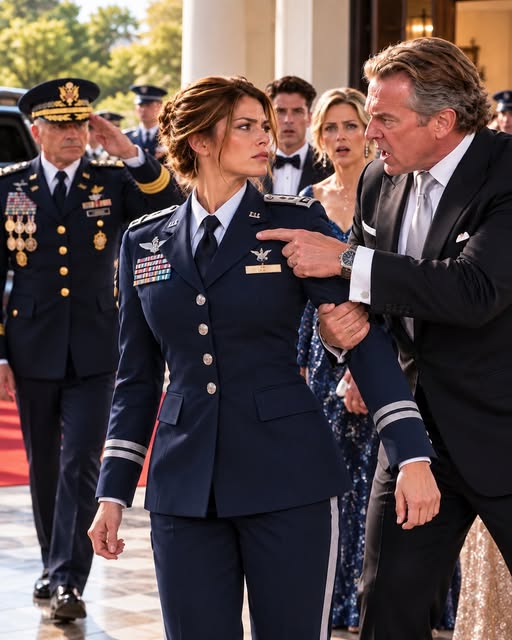
“”Step aside, uniform. You’re blocking the VIP lane,”” a voice snapped, followed by a hard, aggressive shove against my right shoulder.
Twenty-six years in the United States Army had given me a sense of balance most people didn’t possess. I didn’t stumble. I simply adjusted my weight inside my dress blues and turned around to find a young man in an ill-fitting, ridiculously expensive tuxedo trying to force his way past the metal detectors at the White House East Gate.
It was Trevor.
My stepbrother.
Before I could fully process the shock of seeing him again, a heavy hand closed around my bicep like a steel clamp. The grip was brutal, fingers pressing hard into the dark material of my uniform.
“”I told you to move, you incompetent—””
The man’s voice suddenly died in his throat.
I raised my eyes and found myself staring directly into the furious, red face of Arthur Mercer.
My father.
It had been decades since I had seen him this close, but the millionaire CEO of Mercer Defense Tech looked almost exactly the same. He still wore those custom Italian suits and carried the same expression of unquestioned superiority. Behind him stood his second wife, Evelyn, covered in pearls and staring at me as though I were some ugly stain across the polished marble pavement.
“”Kate?””
Arthur tightened his grip, his fingernails pressing painfully through my sleeve. His gaze darted nervously around the security checkpoint, taking in the Secret Service agents, the bomb-sniffing dogs, and finally my uniform.
His expression changed quickly from disbelief to deep, poisonous disgust.
“”What in God’s name are you doing here?””
“”I’m attending the event, Arthur,”” I answered, keeping my voice dangerously calm.
I intentionally lowered my eyes toward his hand until, after a moment, he finally released my arm.
“”Attending?””
Evelyn gave a sharp, mocking laugh while placing one protective hand on Trevor’s arm.
“”Arthur, please. She’s obviously here working security. Just look at her. She’s nothing more than a glorified guard dog.””
Arthur’s eyes narrowed into cold, calculating slits.
Twenty-six years earlier, I had rejected a Wharton MBA and a guaranteed executive position inside his company so I could accept an ROTC scholarship. To him, I hadn’t simply refused his money.
I had humiliated his legacy.
He officially removed me from his inheritance, replaced me with Trevor, and told the men at his golf club that he no longer had a daughter.
“”Listen to me very carefully,”” Arthur hissed.
He leaned so close that I could smell expensive scotch on his breath. His hand grabbed my elbow again, pulling me roughly away from the main walkway and toward the shadow beside a marble pillar.
“”I paid fifty thousand dollars for these donor tickets. I came here to shake hands with the Joint Chiefs and secure a massive DOD contract. I will not allow some low-level sentry to damage my reputation.””
“”You don’t even know why I’m here,”” I replied, keeping my shoulders straight and my expression completely unreadable.
“”I know you’re a failure,”” he spat.
His finger jabbed firmly against my chest, directly over my ribbons.
“”You threw away a dynasty so you could play soldier in the mud. And now I’m a VIP guest at the White House while you’re checking ID badges at the entrance.””
He moved even closer.
“”So here is exactly what you’re going to do. You are going to step back, keep your mouth shut, and pretend you don’t know us. Do not speak to me. Do not look at me. And do not embarrass me today.””
Before I had the chance to answer, the Secret Service agent stationed at the main scanner suddenly shouted,
“”Code Red verification! Clear the lane! Stand down!””
The heavy steel barricades slammed closed.
The crowd of wealthy donors immediately gasped and began murmuring in alarm. Trevor stumbled backward and nearly knocked over one of the stanchions.
Arthur, meanwhile, puffed out his chest, clearly irritated by the unexpected delay.
Then the enormous oak doors of the East Gate slowly swung open with a deep, heavy groan.
A man emerged from the White House, walking with purpose and surrounded by four heavily armed guards.
His chest was covered with a dazzling collection of military medals, while four silver stars gleamed unmistakably across his shoulders.
General Vance.
A current member of the Joint Chiefs of Staff.
Arthur’s expression instantly transformed.
The annoyed scowl disappeared, replaced by an enormous, eager smile.
He abandoned me without a second thought and pushed forward past a Secret Service agent to reach the front of the line.
“”Ah! General Vance!”” Arthur called loudly, eagerly extending his hand. “”Arthur Mercer, Mercer Tech! What an absolute honor that you came out here to greet me personally!””
General Vance didn’t even slow down.
The sheer nerve of her father to say those things directly to her face after 26 years…
But just wait until he realizes who that 4-Star General is actually walking toward.
This is about to backfire on him spectacularly!
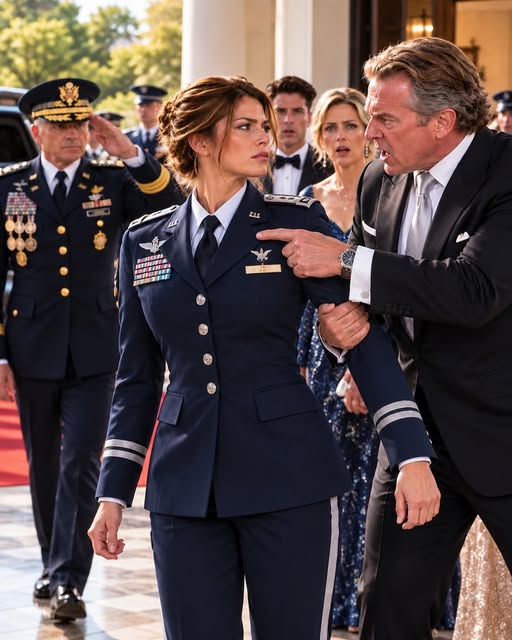
General Vance did not even slow down. He walked straight past Arthur’s outstretched hand as though the billionaire CEO were nothing more than another decorative object beside the security lane. Arthur’s confident smile remained frozen on his face for several humiliating seconds. Then Vance stopped directly in front of me, planted both polished shoes together, raised his right hand, and gave me a crisp, formal salute.
Every conversation around us disappeared.
I returned the salute automatically.
“Lieutenant General Mercer,” Vance said, his voice carrying clearly across the checkpoint. “Madam, the Chairman is waiting for you inside. The National Security staff moved the briefing forward twenty minutes. I came out because I was told your access had been delayed.”
Nobody spoke.
Arthur’s hand was still hanging in the air behind him.
Trevor stared at the three silver stars on my shoulders as though they had suddenly appeared there by magic.
Evelyn’s mouth opened.
Nothing came out.
General Vance glanced toward the Secret Service supervisor. “Why was General Mercer standing outside the cleared lane?”
The supervisor looked deeply uncomfortable. His eyes moved first toward me, then toward Arthur.
“She wasn’t delayed by us, General,” he said carefully. “There was… an interaction with another guest.”
General Vance turned.
Only then did he seem to notice Arthur.
For the first time since walking outside, Vance actually looked at the man who had paid fifty thousand dollars for access to the building.
His expression was not impressed.
It was not curious.
It was cold.
“You’re Arthur Mercer.”
Arthur recovered quickly. Men like my father had spent entire careers learning how to recover when rooms stopped behaving the way they expected.
“Yes,” he said, straightening his jacket. “Arthur Mercer. Mercer Defense Tech. General, there seems to have been a misunderstanding. Katherine is my daughter.”
I nearly laughed.
Twenty-six years.
That was how long it had taken him to use that word again.
Daughter.
General Vance looked at me.
“Is that correct?”
I held his eyes.
“Biologically.”
Trevor made a tiny choking sound.
Arthur’s face darkened.
General Vance understood immediately.
“Understood.”
That single word hit harder than any speech could have.
Arthur stepped closer. “Kate, surely we don’t need to—”
“Sir,” the Secret Service supervisor interrupted, holding one hand across Arthur’s path. “Please remain behind the line.”
Arthur stared at the agent in disbelief.
A moment earlier, he had been ordering me away from the VIP lane.
Now he was being prevented from approaching me.
General Vance turned back to me.
“We need to go. They’re ready for your acquisition briefing.”
Arthur heard the words.
His expression changed.
Not dramatically.
Not yet.
But I saw it.
A flicker.
Acquisition briefing.
That meant something to him.
Something serious.
I nodded toward Vance. “Lead the way.”
We had taken only three steps when Arthur called after us.
“Katherine.”
I stopped.
Not because he was my father.
Because of the tone.
For the first time in my memory, Arthur Mercer sounded uncertain.
I turned halfway.
He was standing behind the security barrier with Evelyn and Trevor, surrounded by wealthy donors who were now pretending not to stare while obviously listening to every word.
“What exactly do you do?” Arthur asked.
Twenty-six years ago, when I told him I was joining the Army, he had refused to ask that question.
He had only asked how quickly I intended to ruin my life.
Now he finally wanted to know.
I looked at the three stars on my shoulders.
Then back at him.
“I serve.”
And I walked inside.
The East Wing hallway was bright, polished, and almost unnaturally quiet after the chaos outside. General Vance walked beside me without speaking for several seconds. He knew enough about my background not to immediately fill the silence.
Eventually he said, “That was your father?”
“Yes.”
“The Mercer Defense Tech Mercer?”
“Yes.”
Vance exhaled slowly.
“That complicates things.”
“I already filed the disclosure.”
“I know.”
“Three weeks ago.”
“I read it.”
“Then it doesn’t complicate anything.”
Vance looked at me.
“You understand what is about to happen in that room?”
“Perfectly.”
That was not entirely true.
I understood the professional part.
The personal part was something else.
For almost three decades, I had built my life around one principle: Arthur Mercer did not get to define whether I succeeded.
I had never wanted his money.
I had never wanted revenge.
I had wanted distance.
Now, by a coincidence so absurd it almost felt designed, his company had landed directly inside the largest weapons modernization review of my career.
And I had spent months trying to ensure my relationship with him never contaminated the process.
Vance lowered his voice.
“The Inspector General sent the supplemental report this morning.”
I stopped walking.
“That early?”
“Five thirty.”
“And?”
His expression hardened.
“Worse than expected.”
For a moment, the hallway seemed to narrow.
“How much worse?”
“Subcontractor documentation. Thermal testing. Materials certification. Production traceability.”
My jaw tightened.
“All four?”
“All four.”
I looked toward the closed briefing room doors at the end of the corridor.
“That explains the emergency meeting.”
“Yes.”
Vance paused.
“And there’s one more thing.”
I knew that tone.
“What?”
“The authorizing signatures.”
I waited.
“Trevor Mercer signed three of them personally.”
For the first time all morning, Arthur’s step-son stopped being the arrogant man who had shoved me at a checkpoint.
He became something much more dangerous.
A potential liability inside a defense procurement investigation.
I lowered my voice.
“Does the committee know?”
“They will in six minutes.”
I looked at my watch.
“Then let’s not keep them waiting.”
Inside the secure briefing room were twelve people who could change the future of a defense company without ever appearing on television.
Two senior Pentagon acquisition officials.
Three uniformed officers.
Counsel from the Department of Defense.
Technical specialists.
A contracting officer.
Two inspectors.
General Vance.
And me.
At the center of the table sat a thick gray folder bearing the name MERCER DEFENSE TECH.
There was something surreal about seeing the family name printed across a government investigation.
A name my father had once told me I was no longer worthy to carry.
A name I had spent twenty-six years making irrelevant to my identity.
Yet I had never changed it.
Not because I wanted to honor him.
Because I refused to let him decide which parts of me I was allowed to keep.
The Deputy Secretary entered last.
Everyone stood.
He motioned for us to sit.
“General Mercer, before we begin, I want your disclosure entered formally into the record.”
I opened my folder.
“For transparency, Arthur Mercer, chief executive officer and principal shareholder of Mercer Defense Tech, is my biological father. We have been estranged for approximately twenty-six years. Trevor Mercer, currently listed as executive vice president for strategic programs, is my stepbrother.”
Nobody reacted.
They already knew.
Professional rooms were different from family rooms.
Facts mattered more than drama.
I continued.
“I have no financial interest in Mercer Defense Tech. I own no shares. I receive no trust distributions. I have had no involvement in company operations. I was formally removed from all family estate arrangements in my early twenties.”
The Department of Defense attorney spoke.
“And your recommendation regarding participation?”
“I will provide technical testimony related to the program because I supervised the operational evaluation process. I will not participate in any final contract award decision.”
The Deputy Secretary nodded.
“Accepted.”
That mattered to me.
Whatever happened next could never honestly be called revenge.
Arthur would probably call it that anyway.
Men like him believed consequences were personal whenever they happened to them.
The first slide appeared.
PROJECT SENTINEL SHIELD.
The contract Arthur had come to Washington hoping to secure.
An advanced communications and battlefield coordination system designed to connect aircraft, ground vehicles, unmanned systems, and forward units across contested environments.
The total program ceiling was enormous.
Billions over multiple phases.
Mercer Defense Tech was one of three finalists.
Arthur believed today’s VIP event would help him charm influential people before the procurement decision advanced.
What he did not know was that the most important people involved in the process had already been examining data he could not charm.
The technical director stood.
“We have identified inconsistencies between the performance documentation submitted by Mercer Defense Tech and independent testing conducted at Redstone.”
A chart appeared.
Numbers.
Failure rates.
Temperature thresholds.
System interruptions.
Certification gaps.
The contracting officer leaned forward.
“How significant?”
The director changed slides.
“Potentially disqualifying.”
Silence.
He continued.
“Mercer submitted documentation indicating the core relay units remained within required tolerance across specified environmental ranges.”
Another graph appeared.
“Our independent test produced repeated failures outside those limits.”
An inspector spoke next.
“We initially believed we were looking at prototype variation. We then compared serial records.”
He opened another file.
“The units supplied for government demonstration were not representative of the standard production configuration described in the company’s proposal.”
The Deputy Secretary’s face became very still.
“Say that plainly.”
The inspector did.
“They appear to have provided specially prepared evaluation units while certifying them as production-representative systems.”
Nobody moved.
Then he added the sentence that would eventually destroy Arthur’s belief that money could solve everything.
“And internal documents indicate senior leadership knew.”
Three signatures appeared on the screen.
Two belonged to engineering executives.
The third belonged to Trevor Mercer.
I stared at it.
Trevor’s handwriting had changed since childhood.
But not much.
The oversized T.
The hard downward stroke.
I remembered him at fourteen years old, signing his name across birthday cards our father’s assistant had purchased for him.
Now the same signature sat beneath a certification submitted to the United States government.
General Vance looked toward me.
I kept my face neutral.
The meeting lasted almost ninety minutes.
Nobody shouted.
Nobody made dramatic accusations.
That was not how serious consequences usually began.
They began with folders.
Questions.
Dates.
Technical discrepancies.
Requests for records.
Legal review.
Suspensions.
Quiet decisions made by people who understood that national defense systems were not luxury products.
You could not hide a reliability failure beneath expensive branding.
When the briefing ended, the Deputy Secretary closed the folder.
“General Mercer.”
“Yes, sir.”
“You’re still scheduled to appear at the reception?”
“Yes.”
“So is Mercer?”
“I believe so.”
He exchanged a look with counsel.
“Do not discuss this investigation with him.”
“I won’t.”
“Even if he asks.”
“He can ask anything he wants.”
That earned the smallest hint of a smile.
Vance walked out with me.
“You know he’s going to ask.”
“I know.”
“You know he’s going to assume you did this.”
“I know.”
“You seem remarkably calm.”
I stopped near a tall window overlooking the lawn.
“I spent twenty-six years learning something Arthur never did.”
“What’s that?”
“The difference between control and power.”
Vance raised an eyebrow.
I continued.
“He thinks control means everyone obeys him. Real power is being able to do your job even when somebody is trying to make it personal.”
Vance gave a quiet nod.
“That should be printed above the Pentagon entrance.”
I smiled.
“Too many words.”
By the time I reached the reception hall, Arthur had already recovered enough to rebuild his public personality.
He stood beneath a crystal chandelier speaking with donors, lobbyists, executives, and military guests.
Evelyn remained beside him.
Trevor was drinking water too quickly.
I could tell from across the room that someone had finally explained the insignia on my uniform.
The reaction was almost fascinating.
Whenever I moved through the reception, officers greeted me.
Some saluted.
Others shook my hand.
Civilian officials addressed me as General Mercer.
A senator’s defense adviser stopped me to discuss a readiness initiative.
A senior Air Force officer joked about a meeting we had attended in Brussels.
Every interaction seemed to make Arthur’s face tighter.
He had expected humiliation.
Just not his own.
Eventually he approached.
Evelyn and Trevor followed.
Arthur waited until nobody stood immediately beside me.
Then he spoke through clenched teeth.
“Lieutenant General?”
I looked at him.
“Yes.”
“You are a lieutenant general?”
“That is usually what three stars indicate.”
Trevor looked down at the floor.
Evelyn’s expression sharpened.
Arthur stepped closer.
“How?”
It was the strangest question he could have asked.
Not congratulations.
Not when.
Not what happened during those twenty-six years.
How.
As though rank were a trick I had performed.
“I stayed in the Army,” I answered.
“For twenty-six years?”
“Yes.”
“And you never told me?”
I stared at him.
“You disowned me.”
“That does not mean—”
“It meant exactly that.”
Arthur glanced around nervously.
“Lower your voice.”
I had barely raised it.
Some habits never changed.
Evelyn stepped forward.
“We simply assumed you had remained enlisted.”
I turned toward her.
“I was never enlisted.”
She blinked.
“I entered through ROTC.”
Arthur’s face tightened.
He remembered that part.
The scholarship.
The decision he had called embarrassing.
I continued.
“I commissioned as a second lieutenant after graduation.”
Trevor finally spoke.
“So you’re actually… what? Third from the top?”
I looked at him.
“That isn’t how command structure works.”
His face reddened.
Arthur ignored him.
“What do you command?”
“Currently?”
“Yes.”
“I oversee Army integration for several modernization and readiness programs.”
Arthur’s eyes changed again.
There it was.
The calculation.
The businessman replacing the father.
He no longer saw the daughter he had insulted outside.
He saw access.
Information.
Influence.
Suddenly he smiled.
It was the same smile he used when entering negotiations.
“Well,” he said warmly, “this is certainly unexpected.”
I almost admired the speed.
Twenty minutes earlier, I was a failure.
Now I was an opportunity.
Arthur touched my arm.
This time gently.
“Katherine, perhaps we started badly.”
“We started twenty-six years ago.”
His smile tightened.
“There is no reason to reopen ancient history.”
“You brought it up at the gate.”
Evelyn laughed nervously.
“Emotions were high.”
“You called me a guard dog.”
Her face went pale.
Trevor looked away.
Arthur lowered his voice.
“We were confused.”
“No.”
I looked at all three of them.
“You were comfortable.”
That stopped him.
“You thought I had no status you respected, so you said exactly what you wanted.”
Arthur’s jaw tightened.
“Katherine, this is neither the place nor the time.”
“You finally said something we agree on.”
I turned away.
His voice changed immediately.
“We need to talk about Sentinel.”
I stopped.
Not visibly.
Just enough.
Arthur saw it.
Of course he did.
He had built his fortune by reading tiny reactions across negotiating tables.
“I knew it,” he whispered.
I faced him.
“Knew what?”
“You are involved.”
I gave him nothing.
Arthur moved closer.
“That meeting General Vance mentioned. Acquisition briefing. It was about Sentinel, wasn’t it?”
“I cannot discuss procurement matters with you.”
His face hardened.
“That means yes.”
“No. It means exactly what I said.”
Trevor interrupted.
“Dad, maybe we shouldn’t—”
Arthur raised one hand.
Trevor stopped instantly.
That told me something.
Fear.
Trevor knew more than Arthur realized.
Arthur lowered his voice again.
“Katherine, Mercer Tech has spent eight years developing that platform.”
I remained silent.
“Twelve thousand employees depend on us.”
Still nothing.
“American manufacturing depends on contracts like Sentinel.”
He waited.
When I did not respond, he abandoned patriotism and moved to family.
“I am your father.”
The words almost made me laugh.
Almost.
“You told people you didn’t have a daughter.”
“That was anger.”
“For twenty-six years?”
Arthur’s nostrils flared.
“We both made choices.”
“No.”
I spoke calmly.
“I joined the Army. You chose what happened after.”
For the first time, people nearby began noticing the tension.
General Vance stood twenty feet away speaking with another officer.
He glanced in our direction but did not intervene.
Arthur noticed him.
His voice dropped further.
“Whatever happened between us, do not let it interfere with business.”
“It won’t.”
He studied my face.
“You mean that?”
“Completely.”
Relief appeared.
Briefly.
Then I added, “The process will follow the evidence.”
Trevor nearly dropped his glass.
Arthur turned toward him.
It lasted less than a second.
But I saw it.
So did Trevor.
A look passed between them.
Something was wrong inside the family long before they reached Washington.
Arthur faced me again.
“What evidence?”
“I cannot discuss it.”
“What evidence, Katherine?”
“I already answered.”
He grabbed my wrist.
Not violently enough to attract immediate attention.
But hard enough.
The old instinct.
Ownership disguised as urgency.
Before I could pull away, another voice spoke from behind him.
“Mr. Mercer.”
Arthur released me instantly.
General Vance stood there.
He was smiling.
That somehow made it worse.
“I believe the General has told you she cannot discuss the procurement.”
Arthur straightened.
“Of course. Naturally. We were simply having a private family conversation.”
Vance looked at my wrist.
Then at Arthur.
“Then I recommend keeping it private.”
Arthur’s face flushed.
Vance turned to me.
“General, the Chairman wants to introduce you to the NATO delegation.”
“I’ll be there in a moment.”
Vance nodded and left.
Arthur watched him go.
Then looked at me.
Suddenly, he seemed older.
Not weaker.
Just less certain that the world belonged to him.
“You know something,” he said.
I did not answer.
“You know something about Sentinel.”
Trevor’s voice came quietly.
“Dad.”
Arthur turned.
“What?”
Trevor’s face had lost all color.
“We need to leave.”
Evelyn frowned.
“Why?”
“Now.”
Arthur stared at him.
“What did you do?”
Trevor looked toward me.
That was his mistake.
Arthur followed his gaze.
And everything clicked.
Not the details.
But enough.
Arthur grabbed Trevor by the shoulder and guided him several steps away.
I could still hear them.
“What did you do?”
“Nothing.”
“Do not lie to me.”
“I handled it.”
“Handled what?”
Trevor swallowed.
“One of the testing problems.”
Arthur’s face changed.
“What testing problem?”
“It wasn’t serious.”
“What testing problem?”
Heads began turning.
Trevor lowered his voice.
“The high-temperature failures.”
Arthur went completely still.
“You told me those were solved.”
“They were.”
“Then why do you look like you’re about to collapse?”
Trevor hesitated.
That hesitation answered more than words.
Arthur stepped closer.
“What did you submit?”
Trevor stared at him.
Arthur repeated it.
“What did you submit?”
“I signed the certification package.”
The blood drained from Arthur’s face.
Evelyn whispered, “Trevor?”
He ignored her.
Arthur’s voice was barely audible.
“Which package?”
Trevor finally said it.
“The production-representative validation.”
Arthur closed his eyes.
Only for a second.
When he opened them, rage had replaced panic.
“You idiot.”
Trevor flinched.
“You told me to get the bid through technical review.”
“I told you to solve the problem!”
“We did!”
“Then why are you afraid of her?”
Trevor glanced toward me.
Again.
Arthur turned.
This time when our eyes met, I saw something I had never seen when I was a child.
Fear of me.
Not physical fear.
Not even fear of military rank.
Fear that I knew something he did not.
I walked away before he could speak again.
The reception continued around them as though nothing had happened.
A string quartet played near the windows.
Waiters carried silver trays.
Important people smiled for photographs.
Diplomacy and defense policy mixed beneath chandeliers.
Arthur Mercer stood in the middle of it all while the foundation beneath his company quietly cracked.
An hour later, I was scheduled to speak.
Not about Mercer.
About leadership.
The event honored military modernization partnerships, and my remarks had been prepared weeks earlier.
I stepped onto the platform.
From the audience, I could see Arthur.
Front row.
He had maneuvered himself there somehow.
Of course he had.
Trevor sat beside him looking sick.
Evelyn stared straight ahead.
General Vance introduced me.
“Lieutenant General Katherine Mercer has served our country for more than twenty-six years across operational, command, and strategic assignments.”
Arthur’s face remained motionless.
Vance continued.
“She has deployed overseas multiple times, led soldiers under conditions few people in this room will ever fully understand, overseen major readiness initiatives, and currently serves as one of the Army’s senior leaders responsible for modernization integration.”
Arthur blinked.
Multiple deployments.
He had not known.
Why would he?
He had never asked.
Vance continued.
“Her decorations include the Defense Distinguished Service Medal, the Distinguished Service Medal, the Legion of Merit, the Bronze Star Medal, and numerous campaign and service awards.”
I watched my father.
For decades, he had assumed the ribbons on my chest were decorative clutter belonging to a low-level security employee.
Now someone he desperately wanted to impress was explaining them to him.
But General Vance was not finished.
“And next month, subject to Senate confirmation already advancing through the appropriate process, General Mercer has been nominated for promotion.”
A murmur moved through the room.
Arthur leaned forward.
“To general.”
Four stars.
For the first time that entire day, I genuinely had not expected what happened next.
Arthur stood.
Not intentionally.
His body simply reacted before his mind did.
Every person near him looked up.
He slowly sat back down.
General Vance continued as though nothing had happened.
I stepped to the microphone.
My speech was supposed to last nine minutes.
I spoke for eight.
I talked about responsibility.
About technical integrity.
About the danger of confusing expensive systems with effective systems.
About soldiers trusting equipment because they rarely get the luxury of questioning whether someone cut a corner years earlier in a boardroom.
I never said Mercer.
I never looked directly at Arthur.
I did not have to.
One line changed his expression completely.
“Every signature on a defense certification is a promise made to a service member who may someday depend on that system.”
Trevor lowered his head.
Arthur turned toward him.
The speech ended with applause.
I stepped away from the microphone.
As soon as I reached the side of the platform, a civilian aide approached.
“General.”
“Yes?”
“The DoD counsel asked me to locate Mr. Arthur Mercer and Mr. Trevor Mercer before they leave.”
I looked at her.
“Why?”
She hesitated.
“Formal notice.”
I knew exactly what that meant.
The procurement office was moving faster than expected.
“Do they need me?”
“No, ma’am.”
“Then handle it through normal channels.”
“Yes, General.”
I walked away.
That decision would matter later.
Because Arthur would spend months telling people I had personally destroyed his contract.
But dozens of officials would know something else.
When given the opportunity to involve myself, I had stepped away.
The government did not need an angry daughter.
It had test data.
Arthur was standing near the exit when two officials approached him.
He smiled automatically.
Then one handed him an envelope.
I watched from across the room.
His expression collapsed after the second paragraph.
Trevor read over his shoulder.
Evelyn covered her mouth.
The notice did not terminate anything.
Not yet.
It informed Mercer Defense Tech that action on its Sentinel proposal had been paused pending formal review of potential certification irregularities.
Arthur looked around the hall.
His eyes found me.
He started walking.
Fast.
People moved aside.
He stopped three feet away.
“What did you do?”
Several conversations died instantly.
I remained still.
“Nothing.”
He held up the notice.
“Nothing?”
“I am recused from the award decision.”
“You expect me to believe this is coincidence?”
“I expect you to read the letter.”
His hand shook.
Trevor reached for his arm.
Arthur pulled away.
“You disappear for twenty-six years, climb your way into the Pentagon, and somehow the largest contract in my company’s history gets frozen the day we meet again?”
“I did not disappear.”
My voice stayed calm.
“You removed me from your life.”
“That has nothing to do with this!”
“Correct.”
That stopped him.
“This has nothing to do with our family.”
I pointed toward the paper.
“That is exactly why your problem is much bigger than me.”
Arthur stared.
Trevor whispered, “Dad, stop.”
Arthur rounded on him.
“You knew.”
Trevor said nothing.
“You knew there was exposure.”
“I thought legal had contained it.”
Arthur’s head snapped back.
“Legal?”
Evelyn looked horrified.
“What are you talking about?”
Trevor’s eyes moved rapidly between us.
“I didn’t falsify anything.”
Nobody had accused him yet.
That sentence changed the atmosphere.
Arthur stared at his stepson.
“Why would you say that?”
Trevor realized too late.
“I mean—”
Arthur grabbed the front of his tuxedo jacket.
“What did you sign?”
“Arthur,” Evelyn gasped.
Secret Service moved immediately.
Two agents stepped forward.
Arthur released Trevor before they reached him.
People throughout the reception were staring now.
The polished Mercer family image had finally cracked in public.
Arthur adjusted his cuffs.
“I’m fine.”
One agent replied, “Keep your hands to yourself, sir.”
The humiliation was complete.
But the real destruction had barely begun.
The next morning, I woke before five.
Military habit.
I ran three miles, showered, dressed, and reached the Pentagon before most of Washington finished breakfast.
By seven fifteen, reporters had learned that Sentinel’s procurement timeline had changed.
By eight, Mercer Defense Tech stock was moving.
By nine, journalists were asking whether Arthur Mercer’s daughter had influenced the decision.
I knew that question would come.
So did counsel.
They released the conflict disclosure and recusal documentation.
Dates mattered.
My recusal had been signed weeks before the White House event.
The technical concerns had been documented independently by multiple testing teams.
No decision originated with me.
That should have ended the conspiracy theories.
It did not.
But it gave serious people facts.
At ten seventeen, my phone rang.
Arthur.
I watched it ring.
Then stop.
A voicemail appeared.
Another call came.
Then Trevor.
Then Evelyn.
I ignored all three.
At eleven, my executive assistant entered.
“General, Mercer Defense Tech’s board chairman is on the line.”
That surprised me.
“Not Arthur?”
“No.”
“Name?”
“Samuel Grant.”
I knew him by reputation.
Former aerospace executive.
Independent board chairman.
Serious.
“Put him through.”
The voice on the other end sounded exhausted.
“General Mercer, thank you for taking the call.”
“Mr. Grant, if this concerns Sentinel, I’m legally restricted from discussing the review.”
“I understand.”
“Then what can I do?”
A pause.
“This concerns your father.”
I almost ended the call.
Grant continued quickly.
“The board held an emergency session this morning.”
I said nothing.
“He has been temporarily removed from direct oversight of all government programs pending internal review.”
That got my attention.
“Why are you telling me?”
“Because he is telling directors that you engineered this.”
“Then your directors should read the procurement record.”
“I did.”
Silence.
“That is why I’m calling.”
His voice became quieter.
“There’s something else you should know.”
I waited.
Grant continued.
“Your name came up during the internal review.”
“My name?”
“Yes.”
“How?”
Another pause.
“Twenty-six years ago, when your father removed you from the Mercer family trust, he told everyone the transfer was complete.”
I felt an old door opening somewhere inside my memory.
“And?”
“It wasn’t.”
I sat back.
“What does that mean?”
“The company’s original voting structure included shares placed in trust for both of Arthur Mercer’s biological children.”
I frowned.
“I am his only biological child.”
“Exactly.”
My hand stopped above the desk.
Grant continued.
“The trust could remove you from inheritance distributions.”
“I know.”
“But apparently it could not automatically cancel the founder-class voting shares transferred to you by your grandfather.”
I said nothing.
I barely breathed.
My grandfather.
Thomas Mercer.
The only member of that family who had ever encouraged me to make choices Arthur disliked.
He died when I was nineteen.
Before the Army.
Before the disowning.
Before everything broke.
Grant kept talking.
“Those shares have remained dormant.”
“How many?”
“Eleven-point-eight percent of founder voting control.”
I stood.
That number made no sense.
“That’s impossible.”
“It should have been discovered years ago.”
“Why wasn’t it?”
“We are trying to answer that.”
My voice sharpened.
“Who was voting them?”
Silence.
That silence told me everything.
“Mr. Grant.”
“We believe proxies were submitted.”
“By whom?”
“We don’t know yet.”
“You’re calling me without knowing?”
“I’m calling because outside counsel believes some historical proxy authorizations may not be valid.”
My office suddenly felt too quiet.
For twenty-six years, I believed Arthur had removed me from every part of his empire.
Now I was learning that a piece of it had legally belonged to me the entire time.
Not money.
Control.
Voting power.
And someone may have been using it.
Grant spoke carefully.
“We need your attorney.”
“I don’t have a personal corporate attorney.”
“You’re going to need one.”
I ended the call ten minutes later.
Then I sat alone for another five.
Not moving.
The irony was almost offensive.
Arthur had spent twenty-six years believing he had erased me from the Mercer dynasty.
Apparently his own father had made that impossible.
My grandfather’s old voice returned from memory.
Never let Arthur convince you ownership and worth are the same thing, Katie.
I had been nineteen.
I had rolled my eyes.
Now I understood.
At noon, General Vance entered my office without knocking.
“You look like somebody told you aliens landed.”
“Worse.”
“Congress?”
“Family.”
He immediately sat down.
I told him.
Not classified information.
Not procurement information.
Just the trust.
By the end, he was staring at me.
“So the defense contractor under investigation may be partially controlled by the Army general overseeing related modernization programs.”
“No.”
I pointed at him.
“Do not even say that casually.”
“I said may.”
“My ethics counsel is going to have a heart attack.”
“They’ll survive.”
“I’m disclosing it immediately.”
“Obviously.”
Within an hour, the disclosure was filed.
By afternoon, additional safeguards were in place.
I requested removal from every matter involving Mercer Defense Tech until ownership questions could be resolved.
That decision frustrated people.
It also protected the institution.
Arthur called again.
This time I answered.
“Katherine.”
His tone was different.
No anger.
No superiority.
Just tension.
“We need to meet.”
“No.”
“You spoke to Grant.”
That told me the board had informed him.
“Yes.”
“You don’t understand what he told you.”
“That’s why lawyers exist.”
“Do not bring lawyers into this.”
I almost smiled.
“Now I definitely will.”
“Katherine.”
His voice hardened.
“Those shares were never yours.”
“Grant disagrees.”
“Samuel Grant is trying to save his own position.”
“And you’re trying to save yours.”
Silence.
Then he said something extraordinary.
“I protected you.”
I actually laughed.
Arthur hated being laughed at.
“From what?”
“The company.”
“You disowned me from the company.”
“You think running Mercer is some gift?”
“No.”
“You have no idea what your grandfather created.”
“I know he apparently created a trust you failed to eliminate.”
Arthur went silent.
That struck something.
I continued.
“Did you know?”
Nothing.
“Arthur.”
He hated when I used his first name.
“Did you know those shares still existed?”
His answer came too quickly.
“No.”
I knew he was lying.
Not because I had special insight.
Because I had grown up listening to Arthur negotiate.
When he told the truth, he attacked.
When he lied, he became precise.
“I believed all ownership matters had been resolved through counsel.”
There it was.
Corporate language.
Shield language.
“Then you won’t mind an audit.”
He exploded.
“You stay out of this!”
I held the phone away from my ear.
“This company is my life!”
“No.”
My voice remained calm.
“It is your company.”
“You don’t get to appear after twenty-six years and take it.”
“I didn’t appear.”
I looked across my Pentagon office.
“You found me.”
Then I ended the call.
The next three days changed everything.
Mercer Defense Tech’s internal investigation discovered that the Sentinel problem was not isolated.
It was not some cartoon conspiracy where every product was defective and every executive corrupt.
Reality was more complicated.
Most of the company was legitimate.
Thousands of employees did honest work.
Engineers raised concerns.
Managers argued.
Compliance officers wrote reports.
The problem was that some of those reports had been suppressed, softened, or delayed by executives desperate to meet contract milestones.
And Trevor sat near the center.
He had not designed the equipment.
He had not created the original technical failure.
His mistake was simpler.
He had treated engineering truth like a public relations problem.
An internal email surfaced.
FIX BEFORE REVIEW. DO NOT CREATE ADDITIONAL PAPER TRAIL.
Trevor had written it.
Another followed.
USE DEMO UNITS FOR GOVERNMENT TEST. WE CAN ALIGN PRODUCTION LATER.
That one was worse.
Arthur called me when the email leaked.
This time he did not shout.
“Did you see it?”
“Yes.”
“What do I do?”
The question shocked me.
For my entire childhood, Arthur had never asked me for advice.
Now he sounded like a tired old man.
“I’m not your lawyer.”
“I’m asking as my daughter.”
“You don’t get to activate that title when your stock price drops.”
He went quiet.
I regretted the cruelty immediately.
Not because it was inaccurate.
Because I did not want to become him.
So I added, “Tell the truth.”
Arthur laughed bitterly.
“You think it’s that simple?”
“No.”
“Then why say it?”
“Because complicated consequences don’t make truth complicated.”
He said nothing.
I continued.
“If Trevor signed something improper, don’t hide it. If executives buried engineering concerns, don’t protect them. Protect the employees who did their jobs correctly.”
“You sound like your grandfather.”
That was the first kind thing Arthur had said to me in twenty-six years.
I did not know whether he intended it kindly.
“I’ll take that as a compliment.”
“He would hate what you became.”
There he was.
Arthur again.
I felt something inside me finally detach.
Not break.
Detach.
The last tiny part of me that had still been waiting for his approval.
“No,” I said.
“He would hate that you still think you can speak for dead men.”
I ended the call.
The following Monday, my attorney called.
Her name was Rachel Chen, and within forty-eight hours she knew more about the Mercer family than I had wanted anyone to know.
“The shares are real.”
I closed my eyes.
“You’re certain?”
“Completely.”
“Voting rights?”
“Real.”
“Current value?”
“I thought you didn’t care.”
“I don’t. I need to understand the scale.”
She told me.
I opened my eyes.
The number was absurd.
Not billionaire absurd.
But enough to change almost anyone’s life.
I felt nothing.
That surprised me most.
Money had been the weapon Arthur used when I was young.
Do what I say or lose everything.
I had walked away.
Now the money had come back after I no longer needed it.
Rachel continued.
“But the voting issue is more serious.”
“Explain.”
“Someone has submitted proxy votes associated with those shares for years.”
“Arthur?”
“We can’t prove that.”
“Trevor?”
“No evidence.”
“Then who?”
“We’re tracing records.”
I looked at the wall clock.
“What happens if the proxies were unauthorized?”
“They could invalidate certain historical votes.”
“How many?”
“Potentially several major governance decisions.”
I rubbed my forehead.
“What kind?”
“Board appointments.”
My hand stopped.
Rachel added, “Including Trevor’s appointment as executive vice president.”
That was the twist nobody expected.
Not me.
Not Grant.
And certainly not Trevor.
The man Arthur had chosen to replace me may have received his power using voting rights that legally belonged to the daughter Arthur had thrown away.
I asked the only question that mattered.
“Does Arthur know?”
“Not yet.”
“Don’t tell him.”
Rachel paused.
“I have disclosure obligations.”
“I know.”
“I’ll handle it properly.”
“That’s what I mean.”
A week later, Mercer Defense Tech held an emergency board meeting.
I attended remotely with counsel.
Not because I wanted control.
Because ownership carried responsibilities whether I wanted them or not.
Arthur sat at the head of the table.
Trevor sat two seats away.
Evelyn was not present.
Samuel Grant opened the meeting.
“Before proceeding, counsel needs to address a voting rights discrepancy.”
Arthur stared at the screen.
He could see my face in one of the video boxes.
His jaw tightened.
Counsel explained the trust.
Then the founder shares.
Then the proxy questions.
Trevor slowly turned toward Arthur.
Arthur did not move.
The attorney continued.
“Pending validation, eleven-point-eight percent of founder voting control is recognized as belonging to Katherine Mercer.”
Nobody spoke.
Trevor’s face became white.
Then came the second blow.
“Several prior corporate votes relied on proxy instruments associated with those shares.”
Grant leaned forward.
“Which votes?”
Counsel opened a list.
Board restructuring.
Executive compensation.
Strategic committee appointments.
And finally:
“The 2019 vote confirming Trevor Mercer as executive vice president.”
Trevor stared at Arthur.
“You said you controlled those shares.”
The sentence escaped before he could stop it.
Every person in the room froze.
Arthur’s face changed.
Not anger.
Horror.
Grant leaned forward.
“What did you just say?”
Trevor realized what he had done.
“Nothing.”
Grant’s voice sharpened.
“You said Arthur controlled those shares.”
Trevor looked toward his stepfather.
Arthur said nothing.
That silence was devastating.
Counsel spoke.
“Mr. Mercer, were you aware of the trust interest?”
Arthur finally answered.
“I was advised that Katherine had relinquished family participation.”
“That is not what I asked.”
Arthur’s face reddened.
“I relied on counsel.”
Rachel leaned toward her microphone.
“Which counsel?”
Arthur stared at her.
Rachel repeated the question.
“Which counsel told you that you could exercise voting authority over shares owned by my client?”
Nobody moved.
Arthur looked directly into the camera.
Directly at me.
For the first time in twenty-six years, his entire empire had run out of doors behind which he could hide.
“I did what was necessary to protect the company.”
There it was.
Not denial.
Justification.
Trevor pushed back from the table.
“You told me they were yours.”
Arthur snapped, “Be quiet.”
“You told me Kate had nothing!”
“Trevor.”
“You told everybody!”
Grant struck the table once.
“That is enough.”
The meeting became controlled chaos.
Lawyers requested records.
Directors demanded explanations.
Trevor accused Arthur of misleading him.
Arthur accused Trevor of jeopardizing the company with Sentinel.
Men who had spent years presenting themselves as disciplined executives began turning on one another.
I watched silently from the screen.
This was the dynasty I had supposedly thrown away.
And for the first time, I understood how lucky I had been.
Arthur thought he had punished me by forcing me out.
He had actually freed me.
The board adjourned after three hours.
Arthur was temporarily suspended as CEO pending investigation into governance irregularities.
Trevor was suspended from all duties related to government programs.
Samuel Grant became interim executive chairman.
And I?
I declined a board seat.
Grant called afterward.
“You could take one.”
“I don’t want one.”
“You have voting power.”
“That does not mean I should run a defense company.”
“You understand defense better than anyone here.”
“That is exactly why I shouldn’t.”
He understood.
Conflict mattered.
Integrity mattered more than satisfaction.
I instructed Rachel to place my shares into an independent blind voting arrangement while my military service continued.
Arthur hated that decision more than if I had seized control.
Because he could not portray it as ambition.
I did not want his chair.
I did not want his office.
I did not want revenge.
I wanted the rules followed.
Two months later, I returned to the White House.
This time, there was no donor reception.
No family confrontation.
No shouting at security.
My nomination had advanced.
The confirmation process had been exhausting, public, and intrusive.
My career was examined.
My decisions questioned.
My deployments discussed.
My record challenged and defended.
That was the system.
Eventually, the Senate confirmed the promotion.
Four stars.
General Katherine Mercer.
I stood in a ceremonial room while General Vance pinned the new insignia onto my uniform.
My mother had died years earlier.
My grandfather was gone.
There was no spouse standing beside me.
No Mercer family.
For a moment, I thought that might feel lonely.
Then I looked around.
My former battalion commander was there.
Three soldiers I had once mentored.
My first ROTC instructor.
Officers who had served beside me overseas.
A young captain whose career I had helped save after she admitted a mistake instead of hiding it.
They were my people.
Not because we shared blood.
Because we shared trust.
After the ceremony, an aide approached.
“General, there’s someone asking to see you.”
“Who?”
She hesitated.
“Arthur Mercer.”
I looked toward the hallway.
He stood alone.
No Evelyn.
No Trevor.
No expensive entourage.
He still wore an expensive suit.
Some things never changed.
But he looked smaller.
Not physically.
The certainty was gone.
I walked toward him.
He looked at the four stars on my shoulders.
For several seconds, he said nothing.
Then:
“Congratulations.”
“Thank you.”
His eyes moved over the room.
“These people came for you.”
“Yes.”
“I didn’t know you had so many.”
“Neither did I.”
He almost smiled.
Almost.
Then he looked at me again.
“Trevor resigned.”
“I heard.”
“Evelyn left.”
That surprised me.
“I’m sorry.”
He shrugged.
“I don’t think you are.”
“I’m sorry you’re hurting.”
That made him look at me differently.
Not forgiveness.
Something stranger.
Confusion.
Perhaps Arthur understood cruelty better than kindness.
He reached into his jacket.
For one second, security shifted subtly.
Then he pulled out an envelope.
“What is it?”
“A letter.”
“From you?”
“No.”
He held it toward me.
“Your grandfather.”
I did not take it immediately.
Arthur looked down.
“I found it in the trust records.”
My chest tightened.
“He wrote it shortly before he died.”
“Why didn’t I receive it?”
Arthur did not answer.
That was answer enough.
I took the envelope.
My name was written across the front.
KATIE.
My grandfather’s handwriting.
For the first time that day, my hands shook.
I looked at Arthur.
“You kept this?”
“Yes.”
“For twenty-seven years?”
“Yes.”
“Why?”
He stared toward the floor.
“Because he knew.”
“Knew what?”
“That you would leave.”
I opened the envelope.
Inside was one page.
I read it silently.
Katie,
Your father will spend your entire life trying to convince you that inheritance is proof of love and obedience is proof of loyalty.
Do not believe him.
If you choose the company, choose it freely.
If you choose something else, choose that freely too.
The shares I leave you are not a chain.
They are protection.
One day, Arthur may try to convince you that leaving means losing everything.
I want you to know that nobody can take your name, your choices, or your future unless you surrender them.
Build something that belongs to you.
Grandpa.
I read it twice.
Then a third time.
Arthur stood silently.
Finally I folded the letter.
“He knew you.”
Arthur’s expression hardened slightly.
“He judged me.”
“He understood you.”
“You always preferred him.”
“I preferred being allowed to breathe.”
Arthur looked away.
The ceremony continued behind us.
Laughter.
Handshakes.
Photographs.
Life.
He asked quietly, “Did you know the letter existed?”
“No.”
“You believe me?”
“Yes.”
That seemed to hurt him.
Because there was no triumph in my voice.
Only certainty.
Arthur looked at my uniform again.
“I thought you would quit.”
“The Army?”
“Yes.”
“Why?”
“You hated being told what to do.”
I laughed softly.
“That part is true.”
For the first time, he smiled.
A real smile.
Small.
Tired.
“Your grandfather said the same thing.”
Then the smile disappeared.
“I kept waiting.”
“For what?”
“For you to call.”
I stared at him.
“You told me never to contact you again.”
“I was angry.”
“You changed my phone number.”
He flinched.
“You instructed security not to admit me to the house.”
He said nothing.
“You returned my Christmas card unopened.”
His face tightened.
“I know.”
“You told people you had no daughter.”
“I know.”
“You cannot build a wall and then blame the person outside for not visiting.”
Arthur looked down.
That sentence landed.
For decades, I had imagined this conversation.
Sometimes I imagined yelling.
Sometimes crying.
Sometimes telling him everything he had missed.
My first promotion.
My first deployment.
The night I thought I would not make it home.
The soldiers I lost.
The soldiers who saved me.
The first time someone called me Colonel.
The first time someone called me General.
But standing there, I realized I did not need to give him my pain as evidence.
He had missed my life.
That was already the consequence.
Arthur cleared his throat.
“Can we start again?”
I looked at him for a long time.
“No.”
His face fell.
Then I continued.
“But we can start from here.”
He looked up.
“That is not the same thing.”
“I know.”
“I cannot pretend the last twenty-six years did not happen.”
“I know.”
“I will not protect you from the investigations.”
“I know.”
“If Mercer Tech violated procurement rules, it faces whatever consequences the process determines.”
His jaw tightened.
But he nodded.
“And I will not give you access to military decisions.”
Another nod.
“And if you ever put your hands on me again the way you did at the gate, we are finished.”
Arthur looked embarrassed.
“I understand.”
I held his eyes.
“Do you?”
“Yes.”
That was enough for one day.
Not forgiveness.
Not reconciliation.
A boundary.
Sometimes that is the beginning.
Sometimes it is the end.
Either way, it is honest.
Three months later, the Sentinel review concluded.
Mercer Defense Tech was not destroyed.
That surprised the press.
People wanted dramatic collapse.
Reality was less theatrical and more useful.
The company lost eligibility for the immediate contract phase.
Several executives were removed.
Certification procedures were rebuilt.
Independent engineering oversight became mandatory.
Government investigators continued examining individual conduct separately.
Thousands of ordinary employees kept their jobs.
That mattered to me.
Accountability should target wrongdoing.
Not satisfy revenge.
Arthur permanently stepped down as CEO.
Samuel Grant became chairman.
A respected engineering executive took operational control.
Trevor disappeared from corporate life.
I heard he moved west and began consulting.
We never spoke.
Maybe someday we would.
Maybe not.
Evelyn sent me one letter.
It contained no apology.
Mostly excuses.
I did not respond.
Arthur and I exchanged occasional messages.
Short.
Careful.
He asked about my work.
For the first time, he listened to the answer.
One evening, almost a year after the White House confrontation, he visited Washington.
We had coffee.
No assistants.
No security beyond what my position required.
No contracts.
No inheritance.
Just two people sitting across from each other.
He stirred his coffee for almost a minute before speaking.
“I keep thinking about the gate.”
“So do I.”
“I called you a failure.”
“Yes.”
“I thought you were security.”
“Yes.”
He looked embarrassed.
“Even if you had been security…”
I waited.
He finished quietly.
“I had no right to treat you that way.”
That mattered more than the apology I expected.
Because he finally understood the real problem.
Not that he failed to recognize a general.
That he believed respect depended on rank.
“I appreciate you saying that.”
Arthur looked through the café window.
“I spent my whole life knowing who mattered.”
“No.”
He looked at me.
“You spent your whole life deciding who mattered.”
He nodded slowly.
“There is a difference.”
“Yes.”
We finished our coffee.
Outside, Washington traffic moved beneath a gray sky.
Before leaving, Arthur stopped beside his car.
“Katherine.”
“Yes?”
“When General Vance walked past me that day…”
I smiled.
“What?”
“I thought he was coming to meet me.”
“I know.”
“How?”
“You yelled it loudly enough for half the White House to hear.”
Arthur covered his face.
For the first time in my life, I heard my father laugh at himself.
It felt strange.
Human.
Then he looked at the four stars on my uniform.
“I suppose I deserved that.”
I shook my head.
“That wasn’t the lesson.”
“What was?”
I looked at him.
“The important person wasn’t the general walking toward us.”
Arthur frowned.
“Then who?”
“The woman you thought was nobody.”
He understood.
His expression changed.
And finally, after twenty-six years, Arthur Mercer had nothing to say.
I watched his car disappear into traffic.
Then I turned toward the Pentagon.
Toward my own life.
Toward the career he once called humiliating.
I thought about the young woman I had been when I left his house carrying one duffel bag and an ROTC contract.
Arthur had stood at the doorway and told me that if I walked away from the Mercer name, I would spend the rest of my life regretting it.
He had been wrong about one thing.
I never walked away from my name.
I simply learned that he had never owned it.
The uniform had not saved me.
The stars had not made me important.
The White House had not made me worthy.
Those things only forced Arthur to notice what had been true all along.
I had built a life without his permission.
And when the most powerful man in my childhood finally looked at me and realized he could no longer control the story, I did not need to humiliate him.
I did not need his fortune.
I did not need his company.
I did not even need him to admit that I had won.
Because this was never a war between father and daughter.
It was a choice.
His world had taught him that power came from money, access, titles, and making other people afraid to lose what he controlled.
Mine had taught me something else.
Power was standing at a White House gate while the man who once erased you tried to do it again—and discovering that you no longer needed to fight for your existence.
You already knew who you were.
Arthur had spent twenty-six years believing he had disowned me.
But the truth was much simpler.
He had only removed himself from twenty-six years of my life.
He missed the promotions.
The deployments.
The victories.
The failures.
The friendships.
The soldiers who became family.
The woman I became.
And when he finally saw four stars on my shoulders, he thought those stars were proof that he had misjudged my career.
They were not.
They were proof of how much he had missed.
Because the greatest twist was never that the “mall cop” standing beside him was actually Lieutenant General Katherine Mercer.
It was never even that I was about to become a four-star general.
The real twist was that while Arthur Mercer spent twenty-six years building an empire meant to prove I had made the wrong choice, I had built something he could never buy, inherit, manipulate, or take away.
A life that was completely my own.