Two days earlier, I had been trimming azaleas outside my modest house near Norfolk when a cream-colored envelope arrived from Portsmouth Family Court.
Inside was Case 4238B.
Carter versus Carter.
Plaintiffs: Robert and Margaret Carter.
Defendant: Evelyn Carter.
My own parents were taking me to court.
I sat at my kitchen table staring down at the summons while my dog, Knox, rested his heavy head against my knee.
“Well,” I murmured, rubbing behind his ears, “I guess they finally found another way to speak to me.”
It had been twelve years since I had last gone home.
After I completed BUD/S, my father never came to visit me. My mother sent exactly one message.
“We raised a daughter, not a soldier.”
I read it one time.
Then I stopped waiting for their approval.
I created a life they knew almost nothing about. I served quietly, taking responsibility for missions, logistics, and people whose lives sometimes depended on choices I had to make within seconds.
Then an IED ripped through our convoy overseas.
I returned home with a reconstructed knee, a permanent limp, scars I never talked about, and a pension I almost never mentioned.
Before he died, my grandfather had left me his farmhouse. I had personally paid every property tax bill on that land since 2013, even during deployments when I was thousands of miles from home.
Now my parents were claiming I had abandoned the property.
Even worse, they claimed they had personally covered all the expenses.
I stared at the documents until my jaw began to ache.
This wasn’t a misunderstanding.
It was a lie with a case number attached to it.
That evening, I opened the old Navy chest sitting at the foot of my bed.
The scent of canvas, metal, and faint gun oil drifted up from inside. Beneath carefully folded clothes rested my uniform, my medals, and the flag that had belonged to my closest friend, Lewis.
Knox watched as I lifted the jacket.
“They want to see me?” I whispered.
I slowly ran my hand across the fabric.
“Then they’re going to see exactly who I became.”
Before court the following morning, I drove past Grandpa’s farmhouse.
The old oak tree was dying. Paint peeled and curled away from the siding, and the porch sagged so badly that one corner looked as if it might collapse at any moment.
But I could still picture my grandfather standing there with a hammer in his hand.
He built that place.
My parents didn’t.
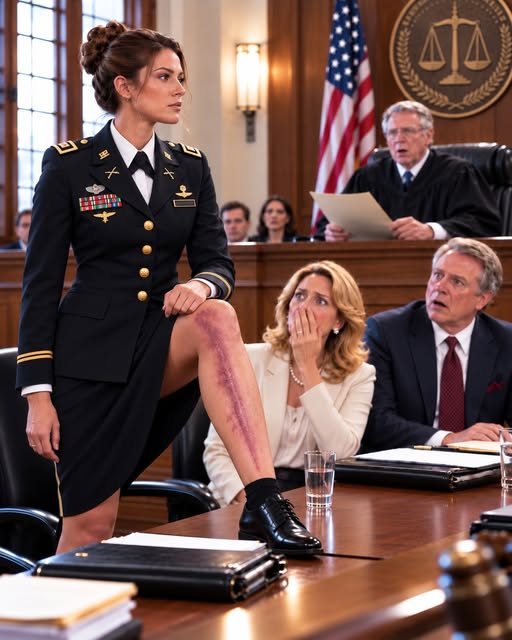
When I got dressed for court, I pinned every medal precisely where it belonged. The jacket fit slightly tighter than it used to, and my injured knee screamed when I tried to stand completely straight.
But the weight across my shoulders felt familiar.
Not comfortable.
Earned.
At the courthouse, conversations faded as I walked down the hallway.
Even an elderly janitor noticed my ribbons, moved aside, and quietly said, “Ma’am.”
When the clerk called Case 4238B, I walked inside without an attorney.
My father looked me over from head to toe with the same cold expression he had worn when I was a teenager.
My mother sat beside him wearing pearls.
Her eyes immediately settled on my uniform.
“Uniform,” she muttered under her breath, as though the word itself embarrassed her.
Dad let out a quiet chuckle.
I didn’t respond.
Judge Simmons entered and took his seat.
After looking through several pages, he turned his attention toward my father.
“Mr. Carter, you’re claiming your daughter abandoned this property?”
“Yes, sir,” Dad replied confidently. “The house has been empty for years. We’ve been paying for everything.”
Judge Simmons gave a slow nod.
Then he looked toward me.
“Commander Carter, would you like to make a statement?”
My father’s smile vanished.
My mother’s fingers tightened around the pearls at her neck.
I stood carefully, ignoring the sharp pain shooting through my knee.
“Yes, Your Honor.”
But before I could say anything else, Judge Simmons reached for the cream-colored case folder.
“Actually, Commander,” he said, “before you answer, there’s something in this file your parents apparently don’t realize that I already know.”
The courtroom became completely silent.
Judge Simmons pulled a document from the folder.
I recognized my grandfather’s signature instantly.
Then I turned my eyes toward my father.
The second he saw that paper, every bit of color drained from his face.
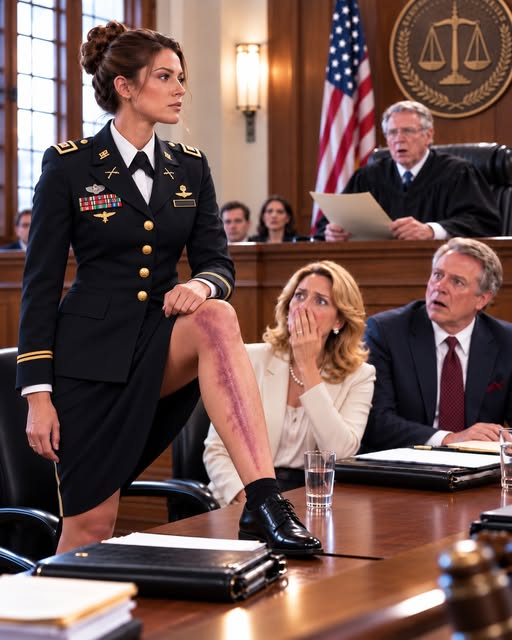
The second my father saw that paper, every bit of color drained from his face.
Judge Simmons did not look at him immediately. He adjusted his glasses, studied the document once more, then rested both hands on the cream-colored folder as if he wanted everyone in the courtroom to understand that whatever happened next would not be based on emotion, family history, or the confidence with which my father had walked through those doors.
“Mr. Carter,” he said quietly, “do you recognize this document?”
My father shifted in his chair.
“I’d need to see it more closely.”
Judge Simmons raised an eyebrow.
“That’s interesting.”
Dad’s attorney, a polished man named Richard Harlan, leaned toward him and whispered something. My mother’s hand was still frozen around the pearls at her throat. She was staring at the signature at the bottom of the page as though she had seen a ghost sitting beside the judge.
I knew that signature.
Arthur James Carter.
My grandfather.
Judge Simmons looked toward me.
“Commander Carter, do you recognize it?”
“Yes, Your Honor.”
“What is it?”
I swallowed.
“I believe it’s my grandfather’s property transfer agreement.”
My father turned sharply toward me.
“You don’t know that.”
It was the first thing he had said directly to me in twelve years.
Not hello.
Not Evelyn.
Not even an accusation.
Just a desperate attempt to make me doubt what was directly in front of us.
Judge Simmons held up one hand.
“Mr. Carter, you will speak when addressed.”
My father sank back into his chair.
The judge unfolded the document.
“This is not merely a transfer agreement. It is a notarized deed accompanied by a recorded declaration executed by Arthur Carter on March eighteenth, 2013. It transfers full ownership of the Carter farmhouse, surrounding acreage, and all associated structures to Evelyn Carter.”
A murmur spread through the courtroom.
Dad’s attorney immediately stood.
“Your Honor, we are aware of the deed. Our argument concerns abandonment and maintenance expenditures subsequent to—”
Judge Simmons looked at him.
“No, Mr. Harlan. Your filing states that Robert and Margaret Carter have maintained continuous financial responsibility for the property since 2013.”
Harlan stopped.
Judge Simmons tapped the page.
“This document contains a provision requiring all property taxes, insurance payments, and structural maintenance records to be retained by the owner.”
He turned another sheet.
“And apparently they were.”
My heartbeat slowed.
Something cold and steady settled inside me.
The judge looked at me.
“Commander Carter, did you bring financial records?”
“Yes, Your Honor.”
“How many years?”
“Thirteen.”
My mother closed her eyes.
I reached for the black folder I had carried into the courtroom.
I had spent half the night assembling it.
Property taxes.
Insurance payments.
Roof repairs.
Well inspections.
County assessments.
Electrical work.
Tree removal.
Every receipt.
Every bank statement.
Every transaction I had authorized from bases, ships, field hospitals, and temporary quarters across three continents.
I placed the folder on the clerk’s desk.
The clerk carried it to Judge Simmons.
My father stared at me.
“You kept all of that?”
I looked at him for the first time.
“You taught me to keep receipts.”
The words hit harder than I expected.
Because it was true.
When I was eight years old, Dad had once made me return to a hardware store after losing a receipt for a box of screws.
“People who can’t prove what they own eventually lose it,” he had told me.
Apparently I had listened better than he remembered.
Judge Simmons opened the folder.
For several minutes, the only sounds were turning pages and the quiet hum of the courthouse ventilation system.
Then he looked up.
“Mr. Carter.”
My father stiffened.
“Yes, Your Honor?”
“Your petition states that you personally paid the 2019 property tax assessment.”
Dad hesitated.
“That is correct.”
Judge Simmons removed a page from my folder.
“This record shows an electronic payment from Commander Carter’s Navy Federal account.”
Dad’s attorney stood again.
“There could have been reimbursement arrangements.”
“There weren’t,” I said.
Harlan looked toward me.
Judge Simmons raised his hand.
“Commander Carter will have an opportunity to testify.”
He turned another page.
“Your petition also states that you replaced the farmhouse roof in 2021 at your own expense.”
Dad nodded faster this time.
“Yes.”
Judge Simmons studied another invoice.
“This invoice from Tidewater Roofing shows payment by Evelyn Carter.”
My mother whispered something to Dad.
He ignored her.
The judge continued.
“You claim you maintained the well.”
Another receipt.
Mine.
“You claim you paid the insurance premiums.”
Mine.
“You claim you repaired the electrical panel.”
Mine.
“You claim you arranged storm cleanup after Hurricane Isaias.”
Mine.
By the sixth document, Dad no longer looked angry.
He looked trapped.
The judge leaned back.
“Mr. Carter, would you like to revise your statement?”
Dad looked at his attorney.
Harlan’s expression had changed completely.
When I walked into the courtroom, he had looked at me the way lawyers sometimes look at people representing themselves.
Confident.
Almost sympathetic.
Now he was looking at my parents.
Not me.
“No,” Dad said.
Harlan turned toward him.
“Robert—”
“No.”
Dad straightened.
“My daughter may have paid bills from time to time, but she abandoned that house. She abandoned this family. She disappeared for more than a decade.”
Something in my chest tightened.
There it was.
The real case.
It had never been about property taxes.
It had never been about a farmhouse.
My father wanted a judge to turn emotional abandonment into legal ownership.
Judge Simmons seemed to understand that too.
He folded his hands.
“Family estrangement does not transfer title to real estate.”
Dad’s jaw tightened.
“She wasn’t there.”
“I was deployed.”
“You chose to leave.”
“I served.”
“You chose that too.”
The courtroom went still again.
My mother finally looked at me.
There was anger in her eyes, but underneath it was something else.
Fear.
Dad pointed toward my uniform.
“You always wanted this. The attention. The medals. The uniform. You chose strangers over your own family.”
I felt every person in the courtroom watching us.
Twelve years of silence had apparently been waiting for a room with witnesses.
I could have yelled.
A younger version of me would have.
Instead, I looked at Judge Simmons.
“May I answer, Your Honor?”
He nodded.
“Yes.”
I turned toward my father.
“I chose a career you didn’t understand.”
His mouth tightened.
“You embarrassed us.”
A strange little laugh escaped me.
Not because anything was funny.
Because after everything I had done, everything I had survived, he still believed my greatest crime was embarrassing him.
“You told people I was unstable.”
Dad’s expression shifted.
“You told Grandma I had joined some reckless military program because I couldn’t handle normal life.”
He said nothing.
“You told Uncle David I had dropped out of college.”
My mother looked down.
“I graduated.”
Silence.
“I earned my commission.”
More silence.
“I completed training.”
Dad stared at the table.
“I led people.”
My voice nearly broke there.
I controlled it.
“I buried people.”
Judge Simmons watched without interrupting.
I continued.
“And while you were telling relatives I had disappeared because I was ashamed to come home, I was paying the taxes on Grandpa’s land from places whose names I wasn’t allowed to tell you.”
Dad looked up.
“That doesn’t make you better than us.”
“No.”
I shook my head.
“It doesn’t.”
I looked at my mother.
“But it means you lied.”
That landed differently.
Mom’s face changed.
Dad’s attorney closed his eyes.
Judge Simmons looked down at the case file again.
“Commander Carter, there is another issue.”
I turned toward him.
“Yes, Your Honor?”
He lifted the document bearing Grandpa’s signature.
“This declaration contains an attachment.”
My stomach tightened.
I had never seen an attachment.
The deed I possessed was only six pages.
Judge Simmons had more.
He noticed my confusion.
“You were not aware of it?”
“No, sir.”
My father suddenly leaned toward his attorney.
Harlan whispered sharply, “What attachment?”
Dad didn’t answer.
That was when I understood.
My father knew.
Judge Simmons opened another section.
“This attachment was sealed with the original filing and was to be disclosed only if ownership of the property was formally challenged by a blood relative of Evelyn Carter.”
For the first time that morning, I forgot about my knee.
I forgot about my parents.
I forgot about the courtroom.
I stared at the judge.
“What does it say?”
Judge Simmons looked at me carefully.
“It appears your grandfather anticipated this.”
My mother whispered, “Robert.”
Dad said nothing.
Judge Simmons began reading.
“Should any member of my immediate family attempt through coercion, fraud, false financial claims, or legal manipulation to obtain the farmhouse from my granddaughter Evelyn, the attached records are to be released to the court.”
My father stood abruptly.
“This is ridiculous.”
“Sit down,” Judge Simmons said.
Dad remained standing.
“Arthur was sick.”
The judge’s expression sharpened.
“Sit down, Mr. Carter.”
Dad slowly lowered himself into the chair.
Judge Simmons continued.
“The records include correspondence, financial statements, and a sworn affidavit.”
My mother’s hand fell away from her pearls.
“Robert,” she whispered again.
This time he looked at her.
She looked terrified.
And suddenly I knew something else.
Whatever Grandpa had hidden in that file, my mother had not known all of it.
Judge Simmons removed a sealed brown envelope.
The courthouse clerk carried it to him.
A date was written across the front.
March 18, 2013.
Underneath it was my grandfather’s handwriting.
For Evelyn, if Robert ever tries.
I could barely breathe.
Dad stared at the envelope.
“You can’t admit that.”
His attorney turned toward him.
“Why not?”
Dad did not answer.
Harlan repeated the question.
“Robert, why not?”
Judge Simmons opened the envelope.
Inside were photocopied bank statements.
Several handwritten letters.
A notarized affidavit.
And one photograph.
The judge studied the photograph first.
Then he looked at my father.
“Mr. Carter, were you involved with Carter Agricultural Holdings?”
Dad stopped moving.
I had never heard the name before.
My mother had.
Her head turned slowly toward him.
“What?”
Dad looked straight ahead.
Judge Simmons repeated it.
“Carter Agricultural Holdings.”
Dad cleared his throat.
“It was an old business.”
“What kind?”
“Land management.”
“Whose land?”
Dad’s attorney whispered, “Robert, answer carefully.”
Dad looked at him.
“Family land.”
Judge Simmons glanced at the documents.
“Specifically your father’s land?”
Dad said nothing.
The judge’s voice became colder.
“Mr. Carter?”
“Yes.”
My mother was staring at him now.
“Robert, what is he talking about?”
Dad turned toward her.
“Not here.”
Her face hardened.
“No. Here.”
Judge Simmons held up a bank statement.
“According to Arthur Carter’s affidavit, in 2011 Robert Carter attempted to use the farmhouse and approximately forty-three acres of surrounding property as collateral for a commercial loan.”
I felt as though someone had tilted the room.
Dad had tried to borrow against Grandpa’s farm.
Before Grandpa died.
Without telling me.
Judge Simmons continued.
“The application valued the property at approximately eight hundred and twenty thousand dollars.”
My father’s attorney looked stunned.
“What loan?”
Dad closed his eyes.
That answer was enough.
My mother stood.
“What loan?”
Judge Simmons looked at her.
“Mrs. Carter, please remain seated.”
She sat down slowly, never taking her eyes off my father.
The judge turned another page.
“The loan application appears to contain Arthur Carter’s signature.”
Dad opened his mouth.
Then closed it.
Judge Simmons lifted the affidavit.
“Arthur Carter swore that he never signed it.”
The silence that followed was absolute.
My father’s attorney pushed his chair backward.
Not far.
Just a few inches.
But I noticed.
So did Dad.
“Harlan.”
His attorney looked at him.
“Did you know about this?”
Dad’s voice dropped.
“This has nothing to do with the current case.”
Harlan’s face changed.
“Did you know about this?”
Dad looked away.
That was the moment his own lawyer understood he had walked into court without knowing the real history.
Judge Simmons continued.
“According to the affidavit, Arthur discovered the loan application after receiving verification paperwork from the lender. He confronted Robert Carter privately.”
My hands had gone cold.
Grandpa had never told me.
Not once.
Judge Simmons read from the affidavit.
“Robert admitted submitting the documents but claimed he intended to repay the loan before Arthur discovered the transaction.”
My mother covered her mouth.
I remembered Grandpa in 2011.
He had been quieter that year.
He stopped inviting Dad to help with repairs.
At Thanksgiving, they barely spoke.
I had thought it was an argument about politics or money or one of the thousand small things fathers and sons sometimes use to wound each other.
It had been this.
Judge Simmons looked at my father.
“Arthur declined to pursue criminal charges.”
Dad finally spoke.
“Because he knew it was a misunderstanding.”
The judge stared at him.
“No.”
He lifted the affidavit.
“According to his sworn statement, he declined because you were his son.”
Dad’s eyes dropped.
“He then transferred the farmhouse to Evelyn.”
My throat tightened.
I understood now.
Grandpa had not simply given me his house because we were close.
He had protected it from his own son.
My father.
Judge Simmons read another line.
“Arthur stated that Evelyn was the only member of the family he trusted never to leverage the property for personal gain.”
Dad laughed bitterly.
“Of course.”
Everyone looked at him.
He shook his head.
“Of course he wrote that.”
His bitterness was almost childlike.
“He always loved her more.”
My mother whispered, “Robert, stop.”
“No.”
Dad pointed toward me.
“She was always his favorite. He took her fishing. Taught her to shoot. Let her follow him around that farm like some little shadow. And when she decided she wanted to play soldier, he encouraged it.”
My jaw tightened.
“I wasn’t playing.”
Dad ignored me.
“He paid for her education. He helped her. He believed everything she did was extraordinary.”
Judge Simmons said nothing.
Dad’s voice grew louder.
“And I was his son.”
There it was.
Not money.
Not property.
Not abandonment.
Jealousy.
A sixty-eight-year-old man sitting in family court was still furious that his father had loved his daughter.
“I worked with him for thirty years,” Dad said. “Thirty years. And he gave everything to her.”
“That isn’t true,” Mom said.
Dad turned toward her.
She looked shaken but determined.
“He gave you the investment accounts.”
Dad stared at her.
“He gave you the equipment.”
Silence.
“He gave you the rental property in Chesapeake.”
Dad’s face tightened.
My mother looked toward the judge.
“Arthur didn’t leave Robert with nothing.”
Judge Simmons watched her closely.
“He left him nearly one million dollars in assets.”
My father snapped, “And that farm was worth more.”
The second the words left his mouth, he realized what he had done.
My mother stared at him.
So did I.
Judge Simmons leaned back.
“So this was about the value.”
Dad said nothing.
The judge looked at the original petition.
“You claimed this action was necessary because the property was deteriorating and had become a financial burden.”
No answer.
“You claimed you wanted to preserve family heritage.”
Dad stared down.
“But you have now stated that your concern is that your sister’s—”
“Daughter,” I corrected softly.
Judge Simmons nodded.
“Your daughter received property worth more than the assets you inherited.”
Dad’s jaw flexed.
His attorney whispered, “Do not answer.”
For once, Dad listened.
Judge Simmons turned toward my mother.
“Mrs. Carter, did you know about the 2011 loan application?”
“No.”
Her answer came instantly.
Dad looked at her.
She looked back at him.
“Did you know?” she asked me.
“No.”
Her eyes returned to Dad.
“You told me Arthur changed his will because Evelyn manipulated him.”
My stomach twisted.
Dad whispered, “Margaret.”
“You told me she pressured him while he was sick.”
“I said not here.”
“And I believed you.”
Her voice cracked.
For the first time that morning, my mother’s embarrassment disappeared.
Something much uglier replaced it.
Realization.
She had come to court believing I had stolen something from the family.
Now she was discovering the story had been built by the man beside her.
Dad leaned toward her.
“We’ll talk at home.”
Mom pulled away.
“No.”
It was a small word.
But it was the first time I had ever heard my mother say it to him with that tone.
Judge Simmons cleared his throat.
“There is still another matter.”
I almost laughed.
Of course there was.
Grandpa apparently had spent his final years preparing legal explosives.
Judge Simmons lifted one of the letters.
“This correspondence references an offer to purchase the property.”
My father went completely still.
The judge looked at him.
“From Mercer Development Group.”
My attorney-less brain immediately began connecting pieces.
I knew that name.
Anyone living near Norfolk did.
Mercer had been buying rural properties for warehouse development and luxury subdivisions.
They had recently acquired land less than three miles from Grandpa’s farm.
I looked at Dad.
“You’re selling it.”
He shook his head too quickly.
“No.”
“You’re trying to take the farm so you can sell it.”
“No.”
Judge Simmons opened the current petition attachments.
“Commander Carter may be closer to the issue than you wish to acknowledge.”
Dad’s attorney turned toward him.
“What did you sign?”
Dad said nothing.
Harlan’s face hardened.
“What did you sign, Robert?”
Judge Simmons answered for him.
“A letter of intent.”
My pulse thudded.
“How much?”
The judge looked at the page.
“Three point four million dollars.”
The courtroom erupted in whispers.
I stared at my father.
Three point four million.
Suddenly the sagging porch made sense.
The dying oak.
The accusations.
The urgency.
My parents had not dragged me into court because they cared about an abandoned farmhouse.
They had a buyer.
My father had apparently promised land he did not own.
Judge Simmons struck his gavel once.
“Order.”
The room settled.
My mother looked physically ill.
“Three million?”
Dad whispered, “Margaret, it wasn’t final.”
“You signed something?”
“It was preliminary.”
“You told me we were saving the farm.”
“We were.”
“No.”
Mom shook her head.
“You told me Evelyn was going to let developers take it because she didn’t care anymore.”
I almost stopped breathing.
He had told her I was the one selling it.
Dad glared at her.
“Enough.”
Mom looked at me.
For the first time in twelve years, my mother truly looked at me.
Not my uniform.
Not my medals.
Me.
“You weren’t selling it?”
“No.”
Her face collapsed.
I hated that part of me felt satisfaction.
I had imagined my parents finally discovering they were wrong more times than I wanted to admit.
But reality did not feel triumphant.
It felt exhausting.
“No,” I repeated.
“I’ve never listed the property.”
My mother swallowed.
“Robert said developers contacted you.”
“They did.”
Dad’s eyes shot toward me.
That surprised him.
I continued.
“Three times.”
Judge Simmons listened.
“I declined.”
Dad whispered something under his breath.
I looked at him.
“The last offer was two point seven million.”
My mother stared at me.
“You turned that down?”
“Yes.”
“Why?”
I thought about Grandpa sitting on the porch with a mason jar of iced tea.
About summer thunderstorms rolling across the fields.
About Lewis visiting during leave and helping me repair the fence.
About every place that disappears because someone decides memory is less valuable than concrete.
“Because Grandpa asked me not to.”
Dad laughed.
“Dead men don’t need land.”
I looked at him.
“No.”
Then I looked at Judge Simmons.
“But living people need to know somebody kept a promise.”
Dad looked away first.
Judge Simmons placed the papers down.
“Mr. Harlan, were you aware of the letter of intent with Mercer Development Group?”
“No, Your Honor.”
Dad snapped, “It wasn’t relevant.”
Harlan slowly turned.
“You retained me to recover property you represented as neglected family land.”
“It is neglected.”
“You did not tell me you had signed a potential sale agreement.”
“It wasn’t binding.”
“You also failed to tell me about the disputed loan documents from 2011.”
“That was fifteen years ago.”
Harlan closed his briefcase.
The sound of the metal clasps snapping shut echoed through the courtroom.
Dad stared at him.
“What are you doing?”
Harlan stood.
“Your Honor, I request permission to withdraw as counsel.”
My father shot to his feet.
“What?”
Judge Simmons frowned.
“On what grounds?”
Harlan chose his words carefully.
“Information presented today substantially conflicts with material representations made to my office regarding the factual basis of this petition.”
Dad grabbed his sleeve.
“You work for me.”
Harlan looked at Dad’s hand.
Then at Dad.
“Remove your hand.”
Dad slowly let go.
Judge Simmons considered the request.
“Given the circumstances, I will permit withdrawal after today’s proceeding. Mr. Carter will receive appropriate notice regarding future appearances.”
Dad sat down hard.
My mother did not move.
Judge Simmons turned toward me.
“Commander Carter, there is another document I believe you need to see.”
He handed a letter to the clerk.
She brought it to me.
Grandpa’s handwriting covered the front.
Evelyn.
Just my name.
My fingers trembled as I unfolded it.
The paper had yellowed slightly.
The first line destroyed whatever control I thought I had.
Evie, if you are reading this, then your father has probably forced you to defend something that was always yours.
I stopped.
The courtroom blurred.
Nobody spoke.
I began reading again.
I am sorry.
Not because I gave you the farm.
Because I did not tell you why.
Your father made a mistake involving this property. I protected him because he was my son, and I have spent years wondering whether that mercy taught him the wrong lesson.
I swallowed hard.
Grandpa continued.
You are going to be angry that I kept this from you.
You have every right.
But I never wanted you to spend your life carrying my disappointment in your father.
That was mine to carry.
Not yours.
My vision blurred.
I blinked until the words returned.
The farm is not a reward.
It is not payment for your service.
It is not proof that I loved you more than anyone else.
It is a responsibility.
You understand responsibility better than most people I have known.
That is why I chose you.
If Robert ever tries to take it, do not fight because you hate him.
Fight because surrendering to a lie teaches the liar that truth has no defender.
I pressed my lips together.
There were three final lines.
And if the day comes when the farmhouse becomes too heavy for you, let it go.
Land should never become a prison.
But make that choice yourself.
Grandpa.
I folded the letter carefully.
Nobody in the courtroom moved.
Judge Simmons gave me several seconds before speaking.
“Would you like a recess?”
I shook my head.
“No, Your Honor.”
My voice sounded different.
Not weaker.
Older.
“Let’s finish it.”
The judge nodded.
He turned toward my father.
“Mr. Carter, do you still wish to pursue your petition for ownership?”
Dad stared at me.
Something in his expression had changed.
I expected anger.
Instead, I saw calculation.
That scared me more.
“Yes.”
My mother turned toward him.
“What?”
Dad ignored her.
“I do.”
Harlan whispered, “Robert, don’t.”
Dad stood.
“Those documents don’t change the condition of the property.”
Judge Simmons frowned.
“The deed establishes ownership.”
“But she neglected it.”
Dad pointed toward me.
“She hasn’t lived there. She hasn’t restored it. She’s hiding behind military paperwork and sentimental letters.”
I felt something inside me settle.
He still thought persistence could become truth if he kept speaking long enough.
Judge Simmons looked at me.
“Commander?”
I stood.
“My father is correct about one thing.”
Dad blinked.
“I haven’t restored the farmhouse.”
My mother looked confused.
I continued.
“I intended to.”
I took another folder from my bag.
Dad stared.
I almost admired the consistency of his mistakes.
He kept assuming I had arrived unprepared.
“I have architectural surveys, structural assessments, and county preservation applications.”
Judge Simmons accepted the folder.
“I planned to convert the farmhouse into a transitional retreat.”
Dad frowned.
“A what?”
I looked at him.
“A place for wounded service members and first responders to stay during long-term rehabilitation.”
The courtroom fell silent again.
I explained.
“Not a hospital. Not a clinic. Just somewhere quiet where families could stay together while someone adjusts to a different life.”
My knee pulsed beneath my uniform.
I continued.
“I spent six months after my injury learning how difficult it can be to come home when everyone thinks coming home means everything is over.”
Judge Simmons glanced through the plans.
There were accessibility ramps.
Restored bedrooms.
A therapy garden.
A workshop in Grandpa’s barn.
A small memorial grove.
Dad laughed again.
“You can’t afford that.”
I looked at him.
“I can.”
His smile faded.
“How?”
I hesitated.
My financial life was none of his business.
But the question had opened a door.
“I received compensation related to my injury.”
Dad scoffed.
“That won’t cover this.”
“No.”
I reached into the folder.
“But this will.”
I handed another document to the clerk.
Judge Simmons examined it.
His eyebrows rose.
My mother leaned forward.
“What is it?”
The judge looked at me.
“You received nonprofit funding approval?”
“Yes, Your Honor.”
“How much?”
“Initial commitment is one point eight million, contingent on zoning and restoration permits.”
Dad stared at me.
“From who?”
“The Lewis Grant Foundation.”
His eyes narrowed.
“Lewis?”
My throat tightened.
“Lieutenant Commander Marcus Lewis.”
My closest friend.
The man whose flag rested in my Navy chest.
The man who never came home.
After his death, his family established a foundation supporting injured service members.
When they learned about the farmhouse, they asked if they could help.
Dad looked at my ribbons.
Then at my face.
“You named it after him?”
“No.”
I shook my head.
“It will be called Arthur House.”
My mother started crying.
Silently.
She turned her face away, but I saw it.
Dad did too.
He looked at her with irritation.
Not sympathy.
That told me more about their marriage than I wanted to know.
Judge Simmons studied the documents for several minutes.
Then he closed the folder.
“Based on the evidence before the court, the plaintiffs have failed to establish any legal basis for transfer of ownership.”
Dad’s face hardened.
Judge Simmons continued.
“Additionally, the petition contains multiple factual claims contradicted by authenticated financial records.”
My father stood.
“Are you accusing me of fraud?”
The judge’s gaze sharpened.
“I am stating what the record shows.”
“You’re taking her side because of that uniform.”
The air changed.
My father had finally lost control.
Judge Simmons stared at him.
“What did you say?”
Dad pointed toward me.
“You called her Commander the second she walked in here. Everyone looks at those medals and suddenly she’s some hero who can’t possibly lie.”
I whispered, “Dad.”
He turned.
“No.”
His voice cracked through the room.
“You’ve been doing this your whole life. Making people admire you.”
I stared at him.
“You think I wore this for admiration?”
“Yes.”
That answer hurt more than I expected.
Maybe some part of me had still been waiting for him to say he understood.
Even now.
Even after twelve years.
Judge Simmons spoke.
“Mr. Carter, Commander Carter’s military service has no bearing on the ownership documents.”
Dad laughed bitterly.
“Then why did you know who she was?”
The judge became very still.
Dad noticed.
So did I.
Judge Simmons looked toward me.
Then back at my father.
“You really don’t know.”
Dad frowned.
“Know what?”
The judge hesitated.
For a moment, the courtroom was no longer about land.
Something else was moving underneath the surface.
Judge Simmons removed his glasses.
“Commander Carter and I have never met before today.”
Dad shrugged.
“Exactly.”
“But I knew her name.”
My pulse quickened.
The judge looked at me.
“Eight years ago, my nephew was serving overseas.”
I stopped breathing.
“He was part of a logistics unit attached to a convoy that was struck during an ambush.”
The room seemed to narrow.
Judge Simmons continued.
“My nephew survived.”
My injured knee suddenly felt like it was on fire.
I knew where this was going.
Dad did not.
The judge’s voice softened.
“He told my sister that a naval officer ignored evacuation orders long enough to coordinate extraction of several wounded personnel.”
I closed my eyes.
Not because I wanted recognition.
Because I remembered the dust.
The shouting.
Lewis.
Judge Simmons continued.
“My nephew remembered the officer’s name.”
My mother stared at me.
Judge Simmons looked directly at my father.
“Evelyn Carter.”
Dad’s face changed.
Judge Simmons nodded toward my chest.
“When Commander Carter entered this courtroom, I recognized a citation ribbon associated with that operation. I wasn’t certain until I reviewed her service designation in the court identification record.”
My mouth went dry.
“That’s why I reacted.”
He looked at me.
“My nephew is alive because people stayed.”
I could not answer.
The memory hit too quickly.
Lewis shouting into the radio.
Smoke covering the road.
Someone calling for a medic.
The unbearable weight of another person across my shoulders.
Then Lewis turning back.
I pushed it away.
The courtroom was not the place.
Judge Simmons noticed.
He did not continue the story.
He simply said, “Thank you.”
I nodded once.
That was all I could manage.
Dad stared at me.
For the first time in my life, he had no argument.
My mother looked as though someone had removed the floor beneath her.
“You never told us,” she whispered.
I turned toward her.
“You never asked.”
She flinched.
I regretted the cruelty immediately.
But I did not take it back.
Because it was true.
Dad found his voice.
“So now what?”
Judge Simmons put his glasses back on.
“Now I issue my ruling.”
Dad slowly sat.
“The plaintiffs’ petition to transfer ownership is denied with prejudice.”
I exhaled.
“The court recognizes Evelyn Carter as the lawful owner of the property described in Deed Record 2013-18472.”
My shoulders dropped slightly.
But the judge was not finished.
“Additionally, because material statements in the petition appear inconsistent with documentary evidence, I am referring the relevant portions of the record for review.”
Dad shot upright.
“Review by who?”
Judge Simmons looked at him.
“The appropriate authorities.”
My mother closed her eyes.
Dad’s attorney whispered, “Sit down.”
For the first time, Dad obeyed immediately.
The gavel fell.
“Case dismissed.”
People began shifting in their seats.
I remained standing.
I had imagined victory differently.
Cleaner.
Lighter.
Instead, I felt as if I had opened a door into a room my family had kept locked my entire life.
I gathered my folders.
My hands were steady until I reached Grandpa’s letter.
Then they weren’t.
Judge Simmons noticed.
“Commander.”
I looked up.
“You may retain a certified copy. The original remains in the file.”
“Thank you, Your Honor.”
He hesitated.
Then said quietly, “Your grandfather seems to have known exactly what he was doing.”
I looked at the handwriting again.
“He usually did.”
Outside the courtroom, reporters were waiting.
I had no idea how they knew.
Apparently three million dollars, disputed land, and a uniform attracted attention faster than dignity could escape.
Microphones appeared.
“Commander Carter, do you believe your parents intentionally committed fraud?”
“Are you moving forward with Arthur House?”
“Will you sell the property?”
“What do you think about the judge’s referral?”
I kept walking.
Knox was waiting at home.
That seemed more important.
Then someone grabbed my arm.
I turned sharply.
My mother immediately released me.
“Evelyn.”
I had not heard her say my name in twelve years.
Dad stood twenty feet behind her arguing with Harlan.
I looked at Mom.
“Yes?”
Her eyes were red.
“Please.”
One word.
Too many meanings.
Please listen.
Please forgive me.
Please pretend this morning did not happen.
I did not know which one she meant.
“What?”
She looked toward Dad.
Then back at me.
“I didn’t know.”
I believed her.
That was the problem.
Believing she did not know did not erase everything she had willingly believed instead.
“You knew the case was false.”
“No.”
“You signed it.”
“Robert told me—”
“I know what Dad told you.”
My voice remained quiet.
“I’m asking what you checked.”
She stared at me.
Nothing.
She had checked nothing.
Because believing the worst about me had been easier than questioning him.
Mom looked down.
“He said you hadn’t paid anything.”
“And you believed him.”
“Yes.”
“He said I abandoned Grandpa’s house.”
“Yes.”
“He said I manipulated Grandpa.”
Her face crumpled.
“Yes.”
I nodded.
There was nothing left to argue.
She stepped closer.
“I was angry with you.”
“I know.”
“You left.”
“I was ordered overseas.”
“You stopped calling.”
I looked at her.
“After your message.”
She knew exactly which one.
We raised a daughter, not a soldier.
Her eyes closed.
“I shouldn’t have sent that.”
“No.”
“I was scared.”
“So was I.”
That silenced her.
I had never told her that.
I had been twenty-four when I began the path that eventually separated us.
Determined.
Proud.
Terrified.
I had wanted my mother to tell me she was scared because she loved me.
Instead, she told me I had failed at being her daughter.
Mom whispered, “I thought if I made you feel guilty enough, you’d quit.”
I almost smiled.
“That worked well.”
A tiny, broken laugh escaped her.
Then disappeared.
Behind us, Dad’s voice rose.
“This is not over.”
Every reporter turned.
Dad pushed past Harlan and walked toward us.
Mom stiffened.
He looked at me.
“You humiliated us.”
I stared at him.
“You sued me.”
“You walked in there dressed like that.”
I looked down at my uniform.
“Like what?”
“Making a performance out of it.”
Something inside me finally broke free.
Not anger.
Clarity.
“You still think the uniform is the problem.”
Dad’s face reddened.
“You could have worn normal clothes.”
“I am wearing normal clothes.”
“For court?”
“For me.”
He laughed.
I continued.
“This is who I am.”
Dad stepped closer.
“You think those medals erase what you did to this family?”
“What did I do?”
“You left.”
“You told me not to come home.”
His expression changed.
Mom looked at him.
“What?”
Dad said nothing.
I felt my heartbeat slow again.
Mom turned toward me.
“What did you say?”
I looked at Dad.
He looked suddenly older.
“After I finished training,” I said, “Dad called me.”
Mom’s mouth opened slightly.
“He told me that if I came home wearing the uniform, I shouldn’t bother coming through the door.”
She turned toward him.
“You told me she refused to visit.”
Dad looked away.
That was the second major lie my mother discovered that morning.
Maybe the hundredth.
But this one belonged to her.
“You said she didn’t want us anymore.”
Dad muttered, “She chose the Navy.”
Mom’s face hardened.
“That isn’t what I asked.”
Reporters had stopped asking questions.
Everyone was listening.
Dad noticed them.
“Not here.”
Mom laughed once.
A cold sound.
“You really like saying that.”
She reached up.
For a second, I thought she was adjusting her pearls.
Instead, she unclasped them.
Dad stared.
Those pearls had been his anniversary gift to her.
She held them in her palm.
Then handed them to him.
“Take these.”
He looked confused.
“Margaret.”
“You wanted the farm because you thought you deserved more.”
“Margaret.”
“You lied to me about our daughter.”
“Stop.”
“You lied to me about Arthur.”
His jaw tightened.
She lowered her voice.
“What else did you lie about?”
Dad stared at her.
For the first time, I saw fear.
Not fear of court.
Fear of losing control of the person who had believed him longest.
Mom stepped away.
Dad reached for her wrist.
I moved before I thought.
My hand closed around his forearm.
Not violently.
Firmly.
His eyes widened.
I released him immediately.
“Don’t.”
He stared at me.
The hallway became silent.
My father looked down at my hand.
Then at my ribbons.
Then at my face.
Something finally registered.
I was no longer the twenty-two-year-old daughter he could frighten into silence.
He stepped back.
Mom looked at me.
“Thank you.”
I nodded.
She walked toward the courthouse exit.
Dad watched her leave.
Then turned to me.
“This is what you wanted.”
“No.”
“You wanted to destroy us.”
“No.”
“You always hated me.”
I studied him.
That was another trick.
Turn accountability into persecution.
Make consequences feel like cruelty.
I shook my head.
“I spent years trying not to hate you.”
His expression faltered.
“That’s different.”
I walked away.
He called after me.
“Evelyn.”
I stopped.
He had not said my name in twelve years either.
I turned.
He looked smaller than he had in the courtroom.
“You think you won?”
I considered the question.
Then I answered truthfully.
“No.”
His face changed.
Because he had expected triumph.
“I think Grandpa won.”
I left him standing there.
When I got home, Knox nearly knocked me over.
My knee protested as eighty pounds of German shepherd collided with my legs.
I laughed for the first time that day.
“Easy.”
He ignored me.
Dogs are wonderfully indifferent to courtroom victories.
He wanted dinner.
I changed out of my uniform and hung it carefully.
Then I sat on the floor beside the Navy chest.
Lewis’s flag was still there.
So was Grandpa’s old pocketknife.
For years, I had carried objects belonging to dead men because somehow their weight made absence feel measurable.
That night, Grandpa’s letter lay beside them.
I read it again.
Then again.
At ten thirty, someone knocked on my door.
Knox growled.
I checked the camera.
Mom.
Alone.
I nearly ignored her.
Then I remembered Grandpa’s line.
Do not fight because you hate him.
I opened the door.
Mom stood beneath the porch light carrying a cardboard box.
“What is that?”
“Things your father kept.”
My stomach tightened.
“What things?”
She looked exhausted.
“Yours.”
I let her inside.
She had never been in my house.
Her eyes moved across the walls.
Photographs from deployments.
A shadow box.
A picture of Lewis.
Knox sniffed her shoes suspiciously.
Mom looked at him.
“He’s beautiful.”
“His name is Knox.”
She nodded.
Then she noticed a framed photograph near the fireplace.
Grandpa and me.
I was seventeen.
Covered in mud.
Holding a fishing rod.
He was laughing.
Mom looked away quickly.
She placed the box on my kitchen table.
“I found this in Robert’s office.”
I opened it.
Letters.
Dozens.
All addressed to me.
Some in Mom’s handwriting.
Some from relatives.
Some from Grandpa.
My heart stopped.
“What is this?”
Mom’s face went white.
“I thought you received them.”
I picked up one envelope.
My name.
A military forwarding address.
Unopened.
Another.
Another.
I recognized Grandma’s handwriting.
My aunt’s.
My cousin Sarah’s.
Years of letters.
Hidden.
I looked at my mother.
“What did he do?”
Her voice broke.
“He kept them.”
The room tilted.
I grabbed the edge of the table.
“No.”
“I found them after court.”
“No.”
“I went into his office looking for the Mercer paperwork.”
My breathing became shallow.
“There were two boxes.”
“Two?”
She nodded.
“This is only the first.”
I stared at her.
My mother was crying now.
“He told us you never answered because you wanted nothing to do with the family.”
I picked up a letter from Grandpa.
Postmarked five months before he died.
My fingers shook so badly I could barely open it.
Evie,
Your mother says you are busy. Your father says you do not want visitors.
I don’t believe him.
If you want me to stop writing, you tell me yourself.
Until then, I’m going to assume my granddaughter is still stubborn enough to read an old man’s letters.
I sat down.
Grandpa had written to me.
Dad had hidden it.
Another letter.
Evie,
I heard about your promotion from David.
Proud of you.
Don’t let your father’s silence convince you it belongs to everyone.
Another.
Evie,
The doctors are fussing more than usual.
Nothing worth worrying about yet.
The oak is still standing.
So am I.
My throat closed.
I had believed Grandpa stopped writing because he was disappointed.
Then the final envelope.
Postmarked three weeks before his death.
Evie,
I’d like to see you.
No speeches.
No questions.
Just come sit on the porch if you can.
I pressed the letter against the table.
For twelve years, I had learned to live with regret.
I had told myself duty had cost me my final chance to see him.
It had not.
My father had.
Mom whispered, “Evelyn.”
I stood so quickly the chair fell backward.
Knox jumped.
I walked into the hallway.
I could not breathe properly.
Mom followed but kept her distance.
“He wanted me there.”
“Yes.”
“He asked for me.”
“Yes.”
“And Dad hid it.”
“Yes.”
I hit the wall with the flat of my palm.
Not hard enough to damage it.
Hard enough to feel something outside my chest.
Mom flinched.
“I’m sorry.”
I turned.
“You’re sorry?”
“I didn’t know.”
“You keep saying that.”
Her face folded.
“I know.”
“No.”
I pointed toward the letters.
“You didn’t know about the loan. You didn’t know about the sale. You didn’t know Dad told me not to come home. You didn’t know he hid letters.”
My voice rose despite myself.
“At some point, not knowing became a choice.”
She closed her eyes.
I immediately wished I could pull the words back.
Not because they were false.
Because they were devastating.
Mom opened her eyes again.
“You’re right.”
That stopped me.
No defense.
No excuse.
Just those two words.
“You’re right.”
She walked toward the door.
I watched her.
“Where are you going?”
“Hotel.”
I frowned.
“You’re not going home?”
She shook her head.
“No.”
Something in her voice told me this was not temporary.
Before she reached the door, she turned.
“There’s another box.”
My stomach tightened.
“What’s in it?”
“I don’t know.”
“You didn’t open it?”
“No.”
“Why?”
She looked at me.
“Because your name is written on it.”
The next morning, she returned carrying a metal document case.
My name was indeed written across the top.
EVELYN.
Underneath it, in my father’s handwriting:
DO NOT SEND.
Inside were photographs.
Letters.
Military newspaper clippings.
Printed articles.
My promotions.
My commendations.
My injury.
My return.
Dad had collected everything.
I stared at the contents.
Mom looked confused.
“So he knew.”
I said nothing.
Dad had known.
That was somehow worse.
He had known I graduated.
Known I became an officer.
Known I was promoted.
Known I had been injured.
Known I had returned home.
He had followed my life from a distance while telling everyone I was a failure who disappeared.
At the bottom of the case sat a photograph.
Me stepping off a transport plane after recovering enough to travel.
I remembered that day.
A handful of families had waited behind barriers.
Lewis’s sister had been there.
So had his mother.
In the far corner of the photograph stood a man.
Baseball cap.
Dark jacket.
Hands in pockets.
My father.
I stared.
Mom leaned closer.
“Oh my God.”
He had been there.
He had watched me come home.
And he had not approached.
I sat silently for nearly a minute.
Mom whispered, “Why?”
I knew.
Because walking toward me would have meant admitting that I had become someone without his permission.
Some people would rather lose a relationship than lose control of the story they tell about it.
Mom touched the photograph.
“He went.”
“Yes.”
“He told me he had a conference in Richmond.”
I laughed.
It sounded terrible.
“He drove three hours to watch me come home and then drove away.”
Mom covered her face.
I should have comforted her.
I could not.
My phone rang.
Unknown number.
I answered.
“Commander Carter?”
“Yes.”
“This is Andrew Mercer with Mercer Development Group.”
I looked at Mom.
Her eyes widened.
“What can I do for you, Mr. Mercer?”
“I believe we have a problem.”
“I believe you do.”
He sighed.
“Your father represented himself as having controlling family interest in the Carter property.”
“He doesn’t.”
“We understand that now.”
I waited.
“There is something else you should know.”
Of course there was.
“We paid a deposit.”
I frowned.
“To who?”
“Robert Carter.”
“How much?”
“Two hundred thousand dollars.”
Mom heard me repeat the number.
Her face went pale.
“For what?”
“Exclusive negotiation rights.”
“He had no rights to sell.”
“We understand.”
“Then why did you pay him?”
There was a pause.
“Because he provided documentation indicating he would soon acquire title through court action.”
My blood went cold.
Dad had not merely hoped to win.
He had sold the outcome before the hearing occurred.
“When did you pay him?”
“Six weeks ago.”
Mom sat down.
Six weeks.
Before the lawsuit was even filed.
I asked the only question that mattered.
“Where is the money?”
Mercer sighed.
“That is what we are trying to determine.”
Dad’s house was empty when Mom returned that afternoon.
His car was gone.
So were several suitcases.
His bank account had been partially emptied.
By evening, his attorney could not reach him.
The next morning, neither could the court.
For most of my life, my father had accused me of running away.
Then the first time he faced consequences he could not control, he disappeared.
Three days later, police found his car at a motel outside Richmond.
He had not fled the country.
He had not created some elaborate escape.
He had simply sat alone in a cheap room convincing himself everyone else was responsible.
He was questioned about the Mercer payment.
Investigators also began reviewing the old loan documents Grandpa preserved.
I was not involved beyond providing records.
That mattered to me.
I did not want revenge.
I wanted distance.
Mom filed for separation.
That surprised everyone except, eventually, me.
Their marriage had survived forty-four years partly because my mother had spent too much of it assuming peace meant never questioning my father.
Once she began questioning him, the entire structure collapsed quickly.
Two months after the hearing, she asked to meet me at the farmhouse.
I almost said no.
Then I went.
She was standing beneath the dying oak when I arrived.
The farmhouse looked worse than I remembered.
But contractors had already stabilized the porch.
Orange markers showed where accessibility paths would run.
The old barn had been cleared.
Arthur House was beginning.
Mom looked around.
“I understand now.”
“Understand what?”
“Why he gave it to you.”
I stiffened.
She shook her head.
“Not because you were his favorite.”
I waited.
“Because you preserve things.”
The words hit me unexpectedly.
She walked toward the porch.
“Your father always wanted to turn things into proof that he mattered.”
She touched one of the old wooden posts.
“You turn them into something other people can use.”
I did not know what to say.
Mom looked at me.
“I’m not asking you to forgive me.”
“Good.”
She almost smiled.
“I deserved that.”
We stood beneath Grandpa’s porch in silence.
Finally she said, “Can I help?”
“With what?”
“This.”
She gestured toward the house.
“I don’t want money.”
“I know.”
“I don’t need someone redesigning the project.”
“I know.”
“What can you do?”
She looked at the peeling windows.
“I can paint.”
I laughed despite myself.
Mom smiled.
“I’m serious.”
“You hate painting.”
“I’m seventy years old. Maybe I can develop a new personality.”
That was the first joke we had shared since I was probably nineteen.
So I handed her a scraper.
She lasted forty minutes.
But she came back the next day.
And the day after that.
Rebuilding a farmhouse is easier than rebuilding a family because wood does not remember what you said twelve years ago.
People do.
Some days Mom and I worked comfortably.
Other days one sentence opened wounds neither of us knew how to close.
She apologized often.
Eventually I asked her to stop.
“Apologies aren’t repairs.”
She nodded.
“What is?”
“Time.”
So she gave me that.
No pressure.
No demands.
No questions about when I would forgive her.
Just time.
My father sent letters too.
I returned the first three unopened.
The fourth came through his attorney.
I nearly threw it away.
Instead, I read it.
Evelyn,
I know you believe I hated you.
I didn’t.
That would have been easier.
I was jealous of you.
I stared at the line.
He continued.
My father looked at you the way I always wanted him to look at me.
When you joined the Navy, everyone praised your courage.
When you earned things, people remembered.
I spent my entire life feeling ordinary.
That does not excuse what I did.
I almost stopped reading.
It was the first sentence I had ever seen from him that did not contain a defense immediately afterward.
He wrote about the hidden letters.
The airport.
Grandpa.
He admitted he had intercepted mail.
Admitted he watched me return after my injury.
Admitted he had almost walked toward me.
Then he wrote the line that stayed with me.
I saw you limping and realized you had suffered something I could not fix.
So instead of admitting I was afraid for you, I left before you could see me crying.
I lowered the letter.
For years, I had imagined my father as incapable of feeling.
That was easier.
The truth was worse.
He had felt everything.
Love.
Fear.
Pride.
Jealousy.
Regret.
And instead of learning how to express any of it, he had converted every vulnerable emotion into control.
Understanding that did not forgive him.
But it made him human.
Six months later, Arthur House opened.
We kept the exterior almost exactly as Grandpa remembered it.
Inside, everything changed.
Wide doorways.
Accessible bathrooms.
A rehabilitation room.
Six guest suites.
The barn became a workshop.
The back field became a garden with raised planting beds.
Near the old oak, we placed a stone bench.
Not a monument.
Grandpa would have hated a monument.
Just a bench.
The plaque read:
ARTHUR JAMES CARTER
KEEP YOUR PROMISES.
Lewis’s family attended the opening.
Judge Simmons came too.
So did his nephew.
I recognized him before he introduced himself.
He walked with a cane.
So did I.
For a few seconds, neither of us knew what to say.
Then he smiled.
“Commander.”
I shook my head.
“Evelyn.”
He nodded.
“Evelyn.”
We did not talk about the convoy.
We did not need to.
Sometimes survival does not require a speech.
Just recognition.
Mom stood near the porch wearing jeans covered in paint.
She had become strangely proud of being terrible at renovation.
At one point, I caught her telling a reporter, “My daughter built this.”
I walked over.
“A lot of people built this.”
Mom smiled.
“My daughter corrects people constantly.”
The reporter laughed.
I looked at Mom.
For the first time, hearing her call me her daughter did not hurt.
Then I noticed someone standing beside the road.
My father.
He looked older.
Thinner.
No suit.
No confidence armor.
Just a man standing beside a parked car staring at the house he had nearly destroyed trying to possess.
Mom saw him.
Her smile disappeared.
“Did you invite him?”
“No.”
“Do you want him gone?”
I considered it.
Then I looked at Grandpa’s bench.
“No.”
Dad remained near the road.
He did not approach.
Maybe he finally understood that appearing did not automatically give him the right to enter.
After several minutes, I walked toward him.
He watched me come.
My limp was more noticeable on uneven ground.
His eyes flicked toward my knee.
Then back to my face.
“Looks good,” he said.
“The house?”
He nodded.
“The house.”
“Thank you.”
Silence.
He looked toward the crowd.
“I heard the project was opening.”
“It is.”
“I won’t stay.”
I nodded.
He looked at me.
For once, he did not demand anything.
No forgiveness.
No explanation.
No place in my life.
He reached into his jacket and removed a small wooden object.
Grandpa’s old carpenter’s pencil box.
I recognized it immediately.
My breath caught.
“Where did you get that?”
“Dad gave it to me.”
I stared.
“He used to keep it in the barn.”
“I know.”
Dad handed it to me.
Inside were twelve carpenter’s pencils, most worn almost to nothing.
Underneath them lay a tiny brass key.
“What’s this?”
Dad looked toward the barn.
“Workshop cabinet.”
I frowned.
“There’s no locked cabinet.”
“There is.”
I followed his gaze.
“The back wall.”
Later that evening, after everyone left, I found it.
Behind an old shelving unit was a narrow wooden cabinet built directly into the wall.
The brass key fit.
Inside were notebooks.
Dozens.
Grandpa’s handwriting filled every page.
Farm expenses.
Weather.
Repairs.
Birthdays.
Arguments.
Family history.
And near the final notebook, entries about me.
August 16.
Evie says she wants to join the Navy.
Robert furious.
Margaret afraid.
Girl is stubborn.
Good.
Another.
June 4.
Robert thinks discipline means control.
He has never understood the difference.
Another.
November 21.
Evie called.
She sounds tired but won’t admit it.
Told her the oak survived another storm.
Didn’t tell her I sat awake worrying.
Final pages.
March 18.
Transferred farm today.
Robert will hate me for it.
Maybe he already does.
But property can survive anger.
Family sometimes cannot.
I hope I am wrong.
Then, months later:
If Evelyn comes home, tell her I never thought she abandoned us.
The final entry was dated eleven days before he died.
Couldn’t reach Evie.
Robert says she does not want contact.
I don’t believe him.
If she never comes back, I hope somebody tells her I knew who she was becoming.
I closed the book.
For years, I had thought the deepest wound in my life was that Grandpa died believing I chose not to return.
He had not.
Dad could hide letters.
He could intercept calls.
He could distort stories.
But he had never convinced Grandpa.
That realization changed something inside me.
Not dramatically.
There was no sudden healing.
No cinematic moment where twelve years disappeared.
Just a quiet release.
One burden I had carried was not mine anymore.
Outside, the sun was setting beyond the fields.
Dad was still near his car.
I walked back toward him carrying the notebook.
He looked at it and nodded.
“You found them.”
“You knew?”
“Yes.”
“Why didn’t you destroy them?”
His face tightened.
“Because I’m not proud of everything I did.”
I waited.
He looked toward the farmhouse.
“I just spent a lot of years pretending I was.”
That might have been the most honest thing my father ever said.
I handed him the notebook.
He shook his head.
“No.”
“Read the last pages.”
“I have.”
“Read them again.”
He took it.
His fingers trembled.
I had never seen my father’s hands shake.
He read silently.
When he reached the final entry, his face changed.
He closed the notebook.
“I’m sorry.”
The words were barely audible.
I looked at him.
He tried again.
“I’m sorry.”
I had imagined hearing those words since I was young.
They did not repair anything.
But they mattered.
“I know.”
He looked surprised.
Not I forgive you.
Not it’s okay.
Just I know.
That was all I could give him.
It was also more than he had expected.
He handed the notebook back.
“I’ll go.”
“Dad.”
He stopped.
The word felt strange.
I had not called him that in years.
He turned.
I gestured toward the porch.
“You can see the house.”
He stared.
“Are you sure?”
“No.”
For the first time, he smiled.
A small, exhausted smile.
“Fair enough.”
We walked toward the farmhouse.
He kept his pace slow because of my knee.
He never mentioned that he was doing it.
I pretended not to notice.
Inside, he examined the restored woodwork.
The widened hall.
The photographs of Grandpa.
The workshop plans.
When we reached the dining room, Dad stopped.
On the wall was a framed photograph from 1998.
Grandpa.
Dad.
Me.
Three generations standing beside the old tractor.
I had forgotten the photograph existed.
Dad looked at it for a long time.
“I remember that day.”
“So do I.”
“You dropped the wrench on my foot.”
I laughed.
“You yelled for ten minutes.”
“It hurt.”
“I was nine.”
“You were dangerous.”
We both smiled.
Then the smile disappeared.
Not awkwardly.
Naturally.
Because good memories and bad memories can occupy the same room.
Before leaving, Dad stood on the porch.
Mom was gone by then.
The staff had gone home.
Only Knox moved through the yard.
Dad looked at the fields.
“Mercer would have flattened all of this.”
“Yes.”
“I told myself development was practical.”
“I know.”
“I told myself Dad was sentimental.”
“He was.”
Dad nodded.
“So are you.”
“Probably.”
He looked at Arthur House.
“I’m glad you won.”
I studied him.
“That’s not what you said outside court.”
“I know.”
“What changed?”
He looked toward Grandpa’s bench.
“I stopped thinking losing meant someone else cheated.”
That answer stayed with me.
A year after the court case, Arthur House had hosted thirty-seven families.
A firefighter recovering from spinal surgery planted tomatoes in Grandpa’s garden.
A Navy mechanic relearning how to walk built a rocking chair in the barn.
A paramedic recovering from a catastrophic crash spent three months in the downstairs room with her husband and daughter.
The farmhouse was alive again.
Not preserved behind glass.
Used.
Exactly the way Grandpa would have wanted.
Mom volunteered every Thursday.
She eventually stopped trying to paint and started organizing meals instead.
Dad came occasionally.
Never without asking.
That mattered.
Their divorce became final quietly.
Strangely, they treated each other better afterward than they had during the final years of marriage.
Distance sometimes does what endurance cannot.
Dad’s legal situation took longer.
The development deposit had to be repaid.
Most of the money was recovered.
The decades-old loan issue was complicated by time and evidence, but the newer statements connected to the property case caused consequences he could not avoid.
I never attended those proceedings.
People sometimes assumed I wanted to watch.
I did not.
Accountability does not require an audience.
Two years after the courtroom hearing, I received another cream-colored envelope.
For half a second, my stomach tightened exactly as it had the first time.
Then I saw the return address.
Portsmouth Family Court.
Inside was a letter.
Not a summons.
Judge Simmons was retiring.
He had invited several people whose cases had stayed with him to attend a small courthouse ceremony.
At the bottom he had handwritten one sentence.
Bring the uniform if you want.
I laughed.
Then I went.
I did not wear the uniform.
I wore a navy-blue dress and comfortable shoes because my knee had been particularly difficult that week.
Judge Simmons recognized me immediately.
“Commander.”
“Retired judge.”
He smiled.
“Fair.”
His nephew was there.
So was his sister.
After the ceremony, Simmons pulled me aside.
“I have wondered something for two years.”
“What?”
“Why did you wear the uniform to court?”
I looked toward the old courtroom doors.
The answer seemed simple now.
“My parents spent years acting like it was evidence that I had disappointed them.”
He waited.
“I think I needed to stop hiding the thing they wanted me to feel ashamed of.”
Judge Simmons nodded.
“Did it work?”
I thought about my father laughing when I entered.
My mother whispering uniform like it was an insult.
Then the silence when the documents came out.
The hidden letters.
Grandpa’s notebooks.
Arthur House.
My parents learning who I had become.
I smiled.
“For me, yes.”
On the drive home, I stopped at the farmhouse.
It was raining lightly.
Knox, older now and moving slower, followed me toward Grandpa’s bench.
I sat beneath the oak.
The tree we thought was dying had surprised everyone.
An arborist removed several damaged limbs, treated disease in the roots, and told us there was a chance it could recover.
That spring, new leaves appeared.
Not everywhere.
Some branches remained bare.
Some damage would never reverse.
But the tree lived.
I liked that.
For obvious reasons.
I sat there until the rain stopped.
Then I walked toward the house.
Lights glowed through the windows.
Someone was laughing inside.
Dinner smelled like rosemary and bread.
A family was staying in the east bedroom.
One of the children had left muddy shoes beside the porch.
Grandpa would have complained.
Then secretly smiled.
As I reached the door, my phone vibrated.
A message from Dad.
Saw the article about Arthur House expanding. Proud of you.
Years earlier, I might have stared at those three words for an hour.
Proud of you.
I might have wondered why they had taken so long.
Why he could say them now but not when I needed them at twenty-four.
Why some parents waste years withholding words their children should never have had to earn.
But I had learned something.
Healing did not require rewriting the past into something kinder than it was.
My father failed me.
My mother failed me.
I failed them in ways too.
Love did not erase any of that.
Neither did forgiveness.
But truth gave us somewhere real to stand.
I typed back.
Thank you.
Then, after a moment, I added:
Grandpa would like the new workshop.
Dad answered almost immediately.
He’d complain about the hinges.
I laughed.
Absolutely.
I put the phone away.
Inside Arthur House, a man recovering from surgery was arguing cheerfully with his son over a board game.
Someone had left coffee brewing.
Knox collapsed beside the fireplace.
I stood in the doorway and looked around at the place my father once tried to turn into three point four million dollars.
He had seen acreage.
Grandpa had seen responsibility.
I had finally learned to see both memory and possibility.
That courtroom case was supposed to decide who owned a farmhouse.
Instead, it exposed a family story built on twelve years of lies.
My parents entered believing I was the daughter who abandoned them.
I entered believing they had simply stopped loving me.
Neither story was completely true.
My father had been following my life from the shadows.
My mother had been receiving a carefully edited version of it.
My grandfather had died knowing far more than any of us understood.
And the farmhouse had never really been the inheritance that mattered.
The real inheritance was the final lesson Grandpa left hidden inside a court file.
Responsibility is not ownership.
Love is not control.
Silence is not proof of rejection.
And a lie repeated for twelve years is still only a lie when someone finally brings the receipts.
The next morning, I walked into the barn before sunrise.
A new wooden sign rested on the workbench.
One of the residents had carved it for the entrance.
ARTHUR HOUSE
Below the name was a smaller line.
MAKE YOUR CHOICE YOURSELF.
I stared at it.
Grandpa’s words.
The final instruction from his letter.
Land should never become a prison.
Make that choice yourself.
For most of my life, I had been making choices in response to someone else.
Join because Dad said I shouldn’t.
Stay away because he said I wasn’t welcome.
Prove myself because my parents thought I had failed.
Protect the farm because someone tried to take it.
But standing in Grandpa’s barn that morning, I understood something I had missed.
I did not have to spend the rest of my life being defined by resistance.
I could choose things simply because I wanted them.
So I stepped outside.
The sun was rising behind the farmhouse.
Mom’s car appeared at the end of the gravel road.
She was bringing breakfast for the residents.
A minute later, another vehicle turned in behind her.
Dad.
He had called the night before and asked if the workshop needed help installing new shelves.
I had said yes.
Not because everything was fixed.
It wasn’t.
Not because I trusted him completely.
I didn’t.
But because rebuilding something does not mean pretending it was never damaged.
It means examining every cracked board and deciding which pieces can still carry weight.
Mom parked first.
Dad parked twenty feet away.
They climbed out.
For a second, all three of us stood there looking at one another across the same yard where generations of Carters had argued, celebrated, lied, forgiven, worked, failed, and started again.
Mom lifted a bag.
“Breakfast.”
Dad lifted a drill.
“Shelves.”
I looked down at Knox.
He yawned.
“Apparently everyone has a mission.”
Mom smiled.
Dad did too.
Then we walked toward the farmhouse.
Not as the family we had been.
That family was gone.
Maybe it needed to be.
We walked inside as three people who finally understood that blood does not guarantee trust, history does not guarantee ownership, and forgiveness does not guarantee restoration.
Those things have to be built.
Slowly.
Deliberately.
Honestly.
Like a farmhouse.
Like a life.
Like a family worth returning to.
And as the old screen door closed behind us, I thought about the morning I had entered that Virginia courtroom wearing the uniform my parents once called an embarrassment.
My father had laughed.
My mother had looked away.
Judge Simmons had recognized something they did not.
But the truth was, the medals were never the revelation.
The title was never the revelation.
Even the sealed documents were not the greatest surprise.
The real twist was simpler.
For twelve years, every person in our family had believed someone else had chosen to leave.
Grandpa believed Dad was keeping me away.
Mom believed I refused to come home.
I believed they had stopped wanting me.
Dad believed control was the only way to keep from being forgotten.
And all of us paid for those beliefs.
The courthouse did not save our family.
Truth did not magically repair us either.
It simply removed the lies that had been standing between us.
What happened afterward was our choice.
Grandpa had understood that from the beginning.
That was why he left me the farmhouse.
Not because I was his favorite.
Not because I wore a uniform.
Not because he believed I was better than my father.
He left it to me because he trusted me to understand one thing Robert Carter had spent most of his life refusing to learn.
You cannot force people to love you.
You cannot manipulate them into respecting you.
You cannot own a relationship simply because you share blood.
All you can do is tell the truth, keep your promises, and leave the door open only for people willing to enter honestly.
That evening, I sat on Grandpa’s porch as the sunset turned the Virginia sky orange.
My father was inside installing shelves badly.
Mom was criticizing his measurements.
For once, their argument made me smile.
Knox slept beside my chair.
I held Grandpa’s final letter in my hands.
The paper was soft at the folds now because I had read it so many times.
I stopped at the line that had once sounded like legal advice.
Fight because surrendering to a lie teaches the liar that truth has no defender.
For years, I thought Grandpa was telling me to fight my father.
He wasn’t.
He was telling me to defend reality.
Even when reality hurt.
Especially then.
I folded the letter.
Inside the house, Dad shouted, “Evelyn, where’s the level?”
Mom immediately yelled, “Don’t give him anything. He ignored the level twenty minutes ago.”
I laughed.
Then I pushed myself up carefully, favoring the knee that would never fully heal.
Some injuries stay.
That does not mean they control where you go.
I opened the screen door.
“Top drawer of the workbench.”
Dad appeared in the hallway.
“Found it.”
Mom called from behind him.
“He’s lying. I found it.”
Dad rolled his eyes.
I looked from one parent to the other.
Then toward the photograph of Grandpa hanging beside the staircase.
For half a second, I could almost imagine him standing there.
Work shirt.
Old boots.
That crooked grin.
Watching all of us finally learn the lesson he had buried inside a deed, a letter, and a farmhouse.
I touched two fingers to the frame as I passed.
“Promise kept, Grandpa.”
Then I walked inside.